Whose Cheese Did XPeng Move? Inside the Pile-On Theory
A reposted essay by a Harbin car dealer, amplified by commentator 姬永锋, argues XPeng's October pile-on is structural: Paris, the VW software report and a city-wide L4 licence threaten a rival that sells ADAS rather than cars. The events check out; the coordination claim does not. The essay also concedes real problems, and the record supports those too.
XPeng has had the kind of October a car company remembers. A young product manager at the MONA L05 pre-sale launch called her bosses "lao deng" — a dismissive term for older men — and the clip travelled far beyond the launch. Her apology video was then accused of being AI-generated, after viewers noticed a ring that appeared and disappeared and the platform attached a "suspected AI-generated content" label. Owners of older P7s reported power-unit failures that left cars without drive. And a supplier employee's online claim about quality inspection went viral before XPeng denied it and said it would pursue legal action.
So when 姬永锋, a Weibo commentator who regularly relays XPeng news, reposted a long essay on 28 October titled "Whose cheese did XPeng move?" (小鹏动了谁的奶酪?), he was giving voice to something the company's defenders have been saying all month: that the coverage was not a coincidence.
The essay is not his own. It is credited to "哈尔滨徐总" — a Harbin car dealer, who signs off with a reminder to buy your next car from "Old Xu". That provenance is worth keeping in mind. The repost went up at 16:11 Beijing and had 2 reposts, 14 comments and 93 likes by 17:51 — a niche post carrying a broad claim.
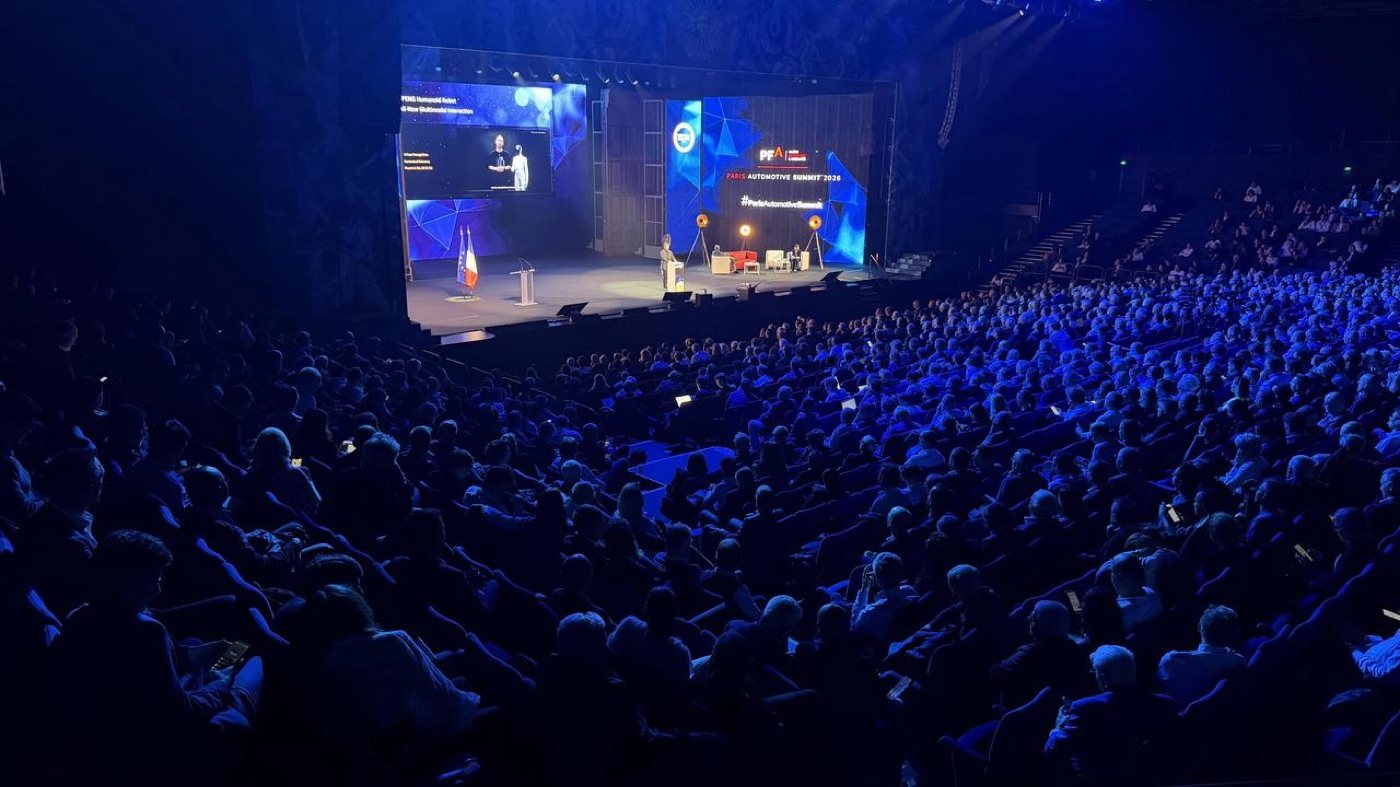
The Paris Automotive Summit hall, 13 October 2026, where He Xiaopeng was the only Chinese automaker CEO on the schedule. Image: 托马斯电火车 on Weibo.
The argument
The essay builds its case in three steps.
First, every car brand has a moat. NIO sells battery swapping; Xiaomi sells chassis and Nürburgring lap times; Li Auto sells fridges, sofas and emotional value; Great Wall sells off-road. XPeng's moat is ADAS.
Second, one competitor is not an automaker. It cannot compete with NIO on swapping or Li Auto on sofas; the only battlefield it shares with every carmaker is ADAS. The essay calls it "有些友商" — certain rivals — and describes a business that sells the system and a "safe and trustworthy" narrative rather than cars.
Third, XPeng has just played three cards that land on that battlefield: the Paris Automotive Summit, where He Xiaopeng was the only Chinese automaker CEO on the schedule and announced that XPeng would sell its platform, E/E architecture and ADAS to outside partners (covered here); the Manager Magazin/Reuters report that Volkswagen may use the architecture it developed with XPeng in about three-quarters of its next-generation VW, Škoda and CUPRA models (reported here); and Guangzhou's city-wide L4 robotaxi licence (covered here). If XPeng's architecture becomes the base of a European giant's volume cars, the essay argues, a rival that sells "the only top-class ADAS" loses part of its story — and that is when material about XPeng becomes "abundant".
What checks out
Four claims, and the record backs all of them.
Paris. The published summit schedule for 13 October puts He Xiaopeng at 11:20, between Volkswagen's Oliver Blume and Renault's François Provost, with Stellantis's Antonio Filosa earlier on the same list. He was the only Chinese automaker CEO on it. His announcement — XPENG AI ENGINEERING — offered the vehicle platform and E/E architecture, modular technology including assisted driving, chips and battery, and the production toolchain.
Volkswagen. On 26 October, Manager Magazin reported that VW's China-developed electronics are billions of euros cheaper than its Rivian software and that brand chief Thomas Schäfer wanted the China code in Europe, covering roughly 75% of next-generation models across VW, Škoda and CUPRA; Reuters carried the report. It remains a consideration — a proposal to group management was expected on 27 October, with no public decision since.
Robotaxi. On 26 October, XPeng received Guangzhou's qualification for L4 demonstration operation across the whole city. The essay calls this the move "from testing to real commercial operation"; the licence is for demonstration operation, and XPeng said it would keep opening the service by invitation code. It is a real step past testing, but not a launch.
The ranking. The essay says a P7's XNGP ranks second in domestic ADAS tests. It does: in P3's 2026 China ADAS benchmark (V1.0), a P7 running "Xpeng NGP with VLA 2.0" scored 4.33, behind a Huawei ADS 4.1-powered S9T at 4.46 and ahead of a Li Auto i8 at 4.06. Huawei has topped that benchmark three years running. The number is right; the tense is not. The benchmark was published in April 2026 — six months before the essay called it recent.
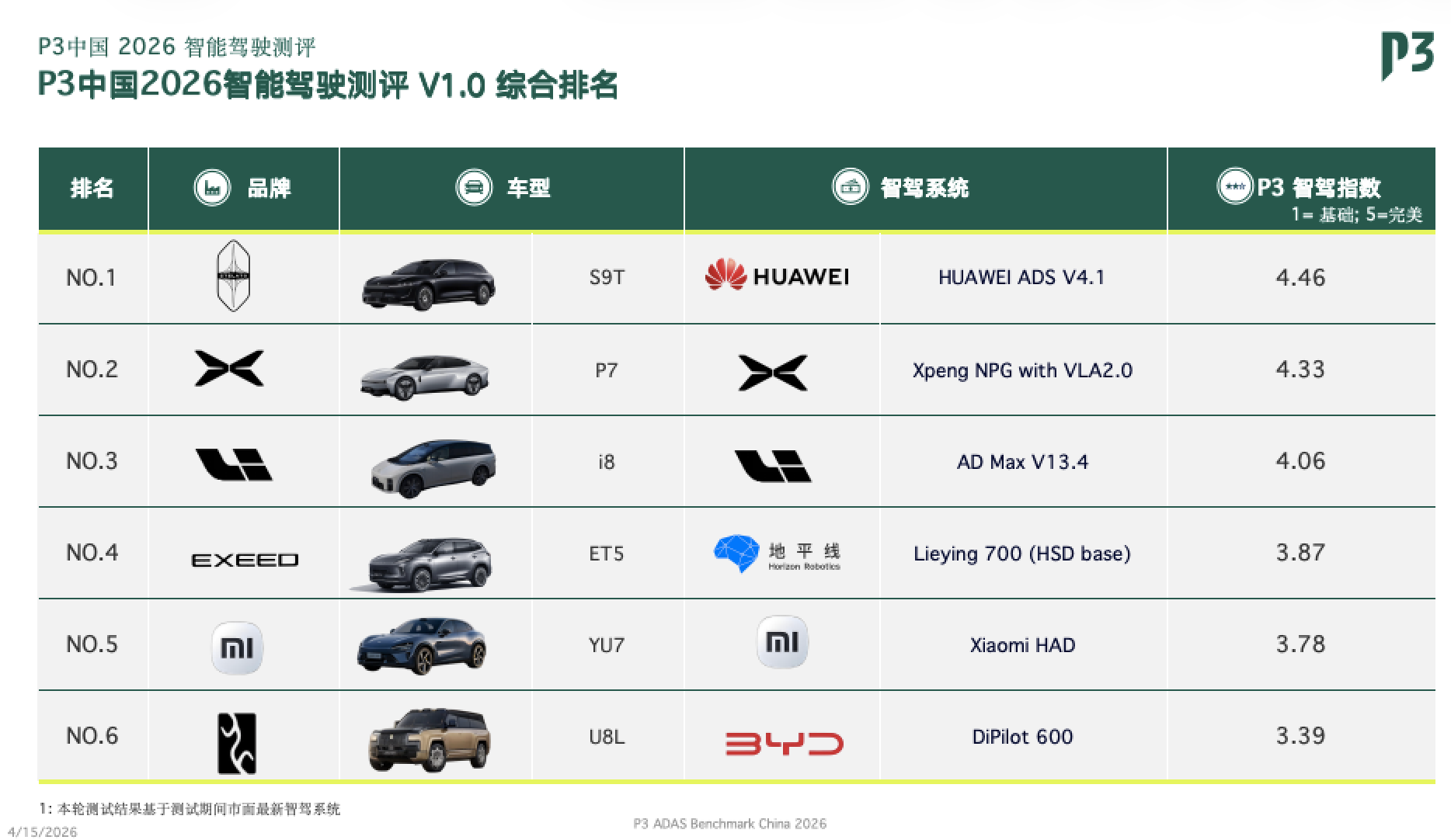
P3's 2026 China ADAS benchmark (V1.0), April 2026: Huawei first at 4.46, XPeng second at 4.33, Li Auto third at 4.06. Image: P3, via 央广网.
The rival it does not name
The essay never names the competitor. The description — a company that does not build cars and sells ADAS to automakers under a safety narrative — is recognisably Huawei's Qiankun ADS business, whose system tops the same P3 ranking. The essay does not name it, and this article is not asserting coordination. But the threat it describes only makes sense with that identity in view: a rival whose pitch is "the best ADAS anyone can buy" being undercut by a carmaker that scores within 0.13 of it on a benchmark and now offers to sell the whole stack to a global OEM.
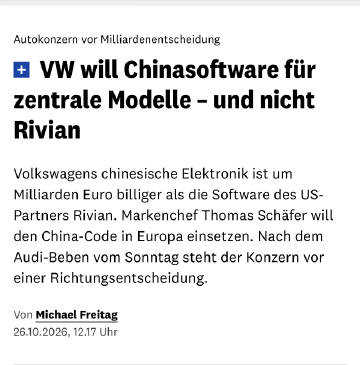
Manager Magazin, 26 October 2026: Volkswagen's Chinese electronics are "billions of euros cheaper" than Rivian's software. Image: Manager Magazin.
What the essay cannot show
What the essay does not offer is evidence of coordination. "Material becomes abundant" is an inference from incentives, not an observation of a campaign; no posts, accounts, budgets or timing are cited. That is not a fatal objection — the incentive is real — but it is an unfalsifiable claim, and it should be read as one.
Press coverage does not need a puppeteer. A viral gaffe, a warranty dispute and a quality rumour generate stories on their own, and competitors will amplify what is already there. The essay is also a participant in the information war it describes: a dealer's essay, reposted by an XPeng-friendly account, with an interest in the conclusion.
More importantly, the negative record is real, and the essay itself concedes it. The "lao deng" apology drew the AI suspicion, and neither XPeng nor the product manager has answered it — the blog covered the apology itself when it was published. The P7 power-unit failures are documented: more than 500 owners in redress groups, a warranty extension to six years and unlimited kilometres announced on 24 October, and complaints about reconditioned parts and requests to delete posts. The supplier rumour was denied by XPeng on 30 September, which said the person was not an employee and had no role in quality inspection, and that it had fixed evidence and would take legal action. None of that needs a campaign behind it.
What survives
Strip the motive claim and the essay still describes a real change in XPeng's position. In October the company stopped being only a carmaker that competes on ADAS and started selling the stack itself: the AI ENGINEERING business, the VW architecture in Europe, a city-wide robotaxi permit. That is a different kind of competitor — to OEMs weighing in-house software, and to any supplier whose pitch is "we are the safe ADAS anyone can buy". The incentive to push back exists whether or not anyone organised it.
What to watch
- Volkswagen's decision. Whether the proposal reaches group management and is approved, and what happens to the Rivian track if it is.
- XPENG AI ENGINEERING's first paying customer. The Paris announcement named none.
- The next P3 benchmark. The April result is the public reference; if XPeng closes the 0.13 gap, the "only top ADAS supplier" story weakens further.
- The P7 warranty dispute. Whether XPeng explains the cause and settles owners who paid for repairs.
- The AI-video question. Whether XPeng or the product manager addresses the suspicion directly.
The bottom line
Whose cheese did XPeng move? On the record, two: the European software base, if Volkswagen's proposal is approved, and the robotaxi permit in its home city. The essay is right that the strategic threat is structural and that October's coverage was relentless; it overreaches when it implies the coverage was manufactured, and it is careless with one date. The useful reading survives both ways: XPeng's problems this month were real, and so is the reason its rivals have started paying attention.
Source: 姬永锋 on Weibo (28 October 2026), reposting an essay credited to 哈尔滨徐总, with the Paris Automotive Summit schedule, Manager Magazin and Reuters reporting, P3's 2026 China ADAS benchmark, and 每日经济新闻, 澎湃新闻 and 界面新闻 — translated & adapted for XPENGTech.
Enjoyed this? Get the next one direct.
New articles, or a daily / weekly digest — delivered to your inbox.