XPeng Yoyo Robotaxi Wins a City-Wide Operating Licence in Guangzhou
XPeng Group has been granted Guangzhou's intelligent connected vehicle demonstration-operation qualification, allowing L4 Robotaxi demonstration operations across the whole city. Its Yoyo service moves from an invitation-only beta in specified areas to a city-wide permit, though XPeng will keep issuing invitation codes and has published no fleet size, fares or staffing. The substance is operations: dispatch, utilisation, service cost and exception handling.
XPeng can now run Robotaxis anywhere in Guangzhou. On the morning of 26 October the company's official Weibo account announced that 小鹏集团 had been granted Guangzhou's intelligent connected vehicle demonstration-operation qualification (广州市智能网联汽车应用示范运营资格), permitting L4-level Robotaxi demonstration operations across the whole city — 广州全域, not a fenced-off test zone.
The wording of XPeng's own post is worth reading closely, because it is careful: the permit takes the business "from technical validation toward validation of operations and the business model" (从技术验证进一步走向运营与商业模式验证). Not to a launch. To validation.
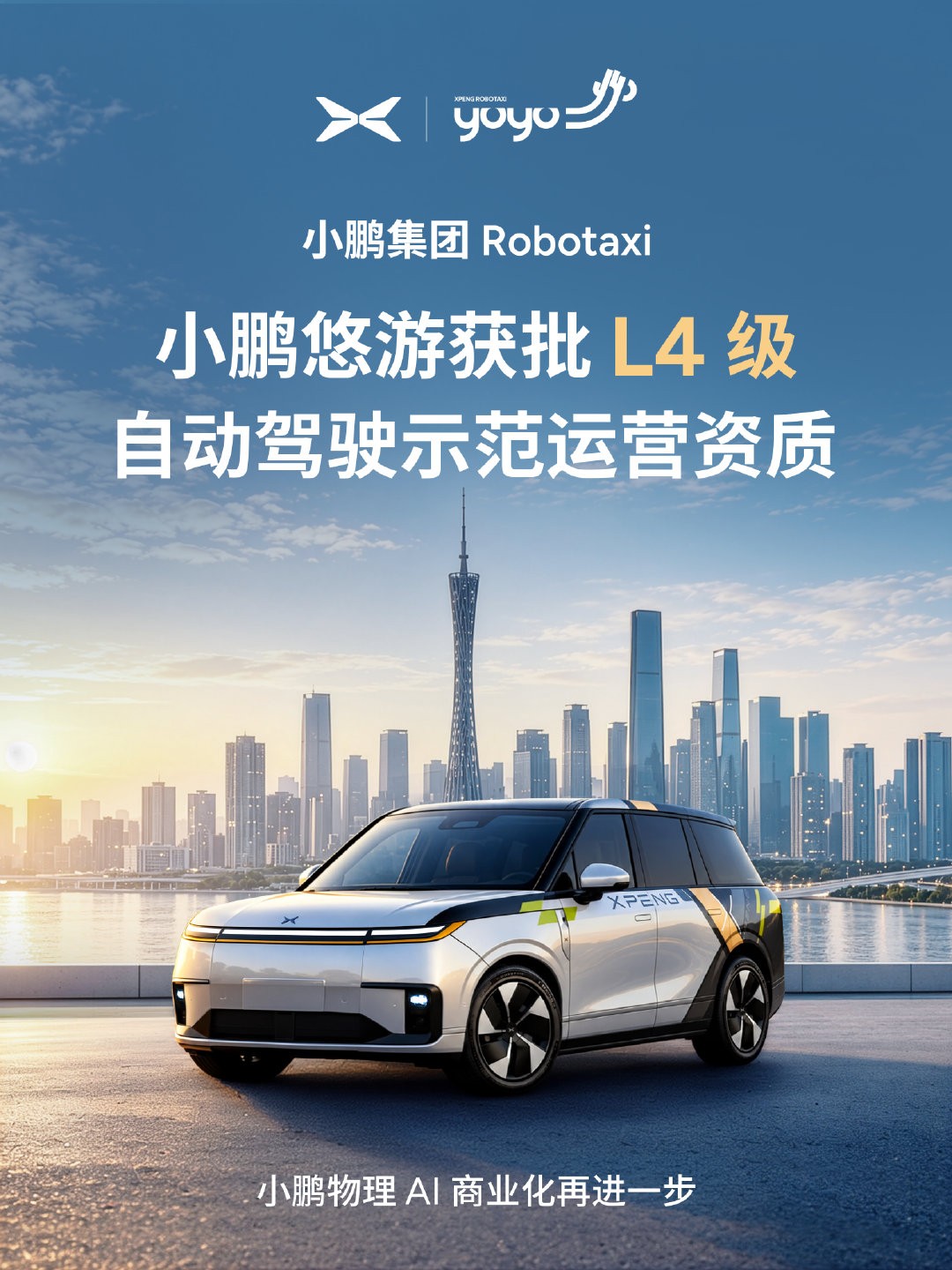
The announcement card: XPeng YOYO has its L4 demonstration-operation qualification, over a Guangzhou skyline. Image: 小鹏汽车 (Weibo).
The post was picked up the same morning by Sina Tech, Cailianshe and Jiemian, all carrying the same two facts: whole-city scope, L4 demonstration operation. Engagement on the official post was still small when we captured it — 8 reposts, 13 comments and 63 likes at 11:52 Beijing, roughly fifty minutes after it went up. The copy from 姬永锋, posted at 11:34, was still at zero on all three counts. For a milestone the company calls "another step in the commercialisation of XPeng Physical AI", the Weibo reaction was muted — the machinery of a corporate announcement rather than a consumer moment.
The permission that matters is not about driving
The most useful line in the Sina Tech report is not about autonomy at all. It argues that for a Robotaxi, demonstration operation is not a further test of driving capability: the car completing the trip is "only one link", and what decides whether the service can keep running is whether order response, vehicle dispatch, passenger pickup and drop-off, service flow and exception handling work together.
That is the correct frame, and it is the one XPeng is now buying into. The company says the team will use the licence to grind through real demand and build operating experience in vehicle utilisation, dispatch efficiency, service cost and fleet management — the four numbers that separate a demo from a business.
What is actually being licensed
The vehicle underneath the permit is not a modified test mule. XPeng bills the Robotaxi as China's first fully in-house developed Robotaxi to achieve pre-installed mass production, and the specification is specific enough to check:
- Built on the flagship GX platform.
- Four in-house Turing AI chips, 3,000 TOPS — XPeng claims the highest in-vehicle compute in the world.
- Second-generation VLA model, operating without HD maps and without LiDAR, on the argument that model generalisation plus a data loop lets it deploy to new cities quickly.
The customer-facing layer is being sold as part of the product too: pre-set cabin temperature and fragrance from the mini-program, zero-gravity seats, massage, and a second-row entertainment screen.
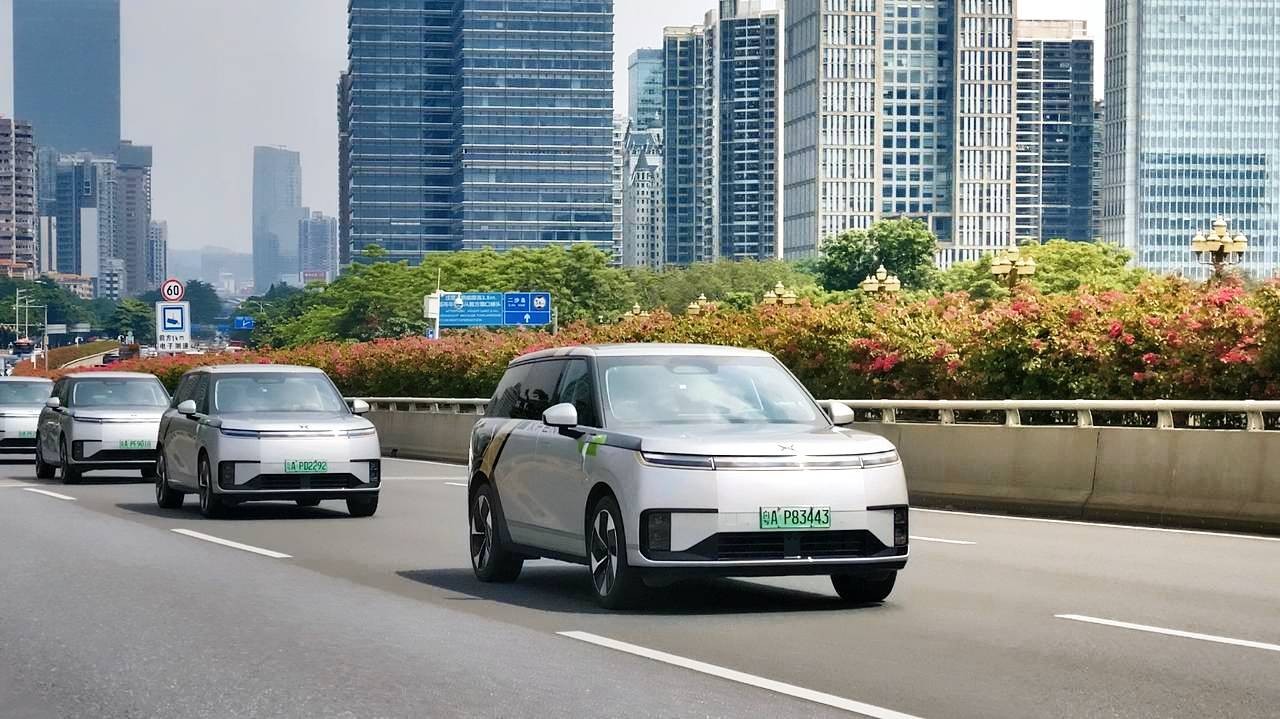
Three XPENG YOYO cars on a Guangzhou elevated road, green plates and roof sensor pods. Image: XPeng.
Two weeks from invitation codes to a city
The licence lands eighteen days after the brand did, and the distance between the two announcements is the story.
8 October — XPeng named the service 小鹏悠游, English name XPENG YOYO, and put the "小鹏YOYO自动驾驶" mini-program live. Coverage at that point was specified areas of Guangzhou only, by invitation code. Riders had to present themselves at designated or suggested pickup points — they could not set an arbitrary pickup location — and destinations were constrained by the covered area and stops. XPeng said plainly that the service was in testing and not formally operating. By then the employee internal test had passed 2,200 orders, and an earlier paid internal test had run at one yuan a ride, mostly to prove the payment and service loop.
26 October — the demonstration-operation qualification, city-wide.
So the sequence runs: production car off the line in May, full chain from in-app booking to automated pickup and drop-off in July, Guangzhou's remote-testing qualification in August (no safety operator in the driver's seat, on Class I, II and III test roads), brand and invitation beta in October, and now an operating licence for the entire municipality.
What XPeng has not said
Four things the announcement does not cover, all of which matter more than the licence itself:
- Fleet size. No number of vehicles in service, or planned.
- Whether a safety monitor rides along. The August qualification was specifically about removing the driver-seat operator on test roads; XPeng has not said what staffing the demonstration service runs under.
- Fares. The one-yuan internal test was a payment-system exercise, not a price.
- Who operates it. XPeng has described itself as a technology provider and ecosystem enabler — revenue from hardware sales, services and commission sharing, with local operations left to partners. As of the 8 October briefing, the company said it does not run the fleet itself. The new licence is XPeng's, but the cars on the road may not be XPeng's to dispatch.
And one more, softer: the announcement says the service will continue to open gradually by invitation code during the early demonstration period. A whole-city licence does not mean a whole-city service this week.
Sell the stack, not the ride
The business model He Xiaopeng has described is unusual for this sector, and it explains why XPeng is comfortable starting with a licence rather than a launch. XPeng positions itself as technology provider and ecosystem enabler: it sells the vehicle platform, the autonomous-driving software and the AI capability as one solution, takes hardware revenue, service revenue and a share of commission, and hands offline operations to global partners.
That is the same logic as its car business turned inside out. WeRide and Pony.ai built robotaxi fleets and went looking for operators; XPeng built a Robotaxi out of a car it already makes and is going looking for fleets to sell it to. Guangzhou calls the three of them the city's "autonomous driving three" — 文远, 小马 and now 小鹏 — with WeRide and Pony already running commercial services in the city. XPeng is the late one, and the one with a factory.
The 2028 claim, and why this does not contradict it
Five days ago at the World Intelligent Connected Vehicles Conference in Beijing, He Xiaopeng told a panel that L4 technology would mature in the second half of 2028, with policy landing somewhere between 2028 and 2032, and that a real L4 company has to start with Robotaxi because it demands a 100-fold safety factor. That argument is worth reading in full.
A city-wide L4 demonstration licence in October 2026 looks like a contradiction. It is not, quite. He was talking about a product a customer buys and a legal framework that assigns liability; this is a supervised demonstration service that still begins with invitation codes. The gap between "we can operate across Guangzhou" and "you can hail one" is precisely the gap his 2028 date describes — and running the operations now is how a company finds out whether that date is right.
Overseas, the same motion is starting. At the Paris motor show He Xiaopeng said XPeng Robotaxi was in talks with several leading European mobility platforms, with details to come. The Guangzhou operating experience is being positioned as the reference case for those conversations.
The bottom line
Strip the language back and today's news is one line: XPeng's Robotaxi business now has the paperwork to operate a real service in a real city, and it has said it will still hand out invitation codes while it learns to run one. The hardware story — 3,000 TOPS, no LiDAR, no HD maps, a GX with a roof pod — was already told in May. What is new and testable is whether XPeng can dispatch cars, price rides, keep vehicles utilised and handle the exception at the kerb. Those are the numbers to watch, and XPeng has not published a single one of them yet.
Source: 小鹏汽车 and 姬永锋 on Weibo (26 October 2026), with XPeng's 8 October press release and reporting from 新浪科技 and 财联社 — translated and adapted for XPENGTech.
Enjoyed this? Get the next one direct.
New articles, or a daily / weekly digest — delivered to your inbox.