A 4B Model Beat GPT-6 Astra at Perception. XPeng Gave It Away.
XPeng's GroundingPI scores 73.68 against GPT-6 Astra's 71.54 across 34 perception benchmarks - but the model shipped to Hugging Face five weeks before the announcement. What the benchmark means, the 50%-data claim that matters more, the Kimi K3 licence detail the statement left out, and what it does not mean for your car.
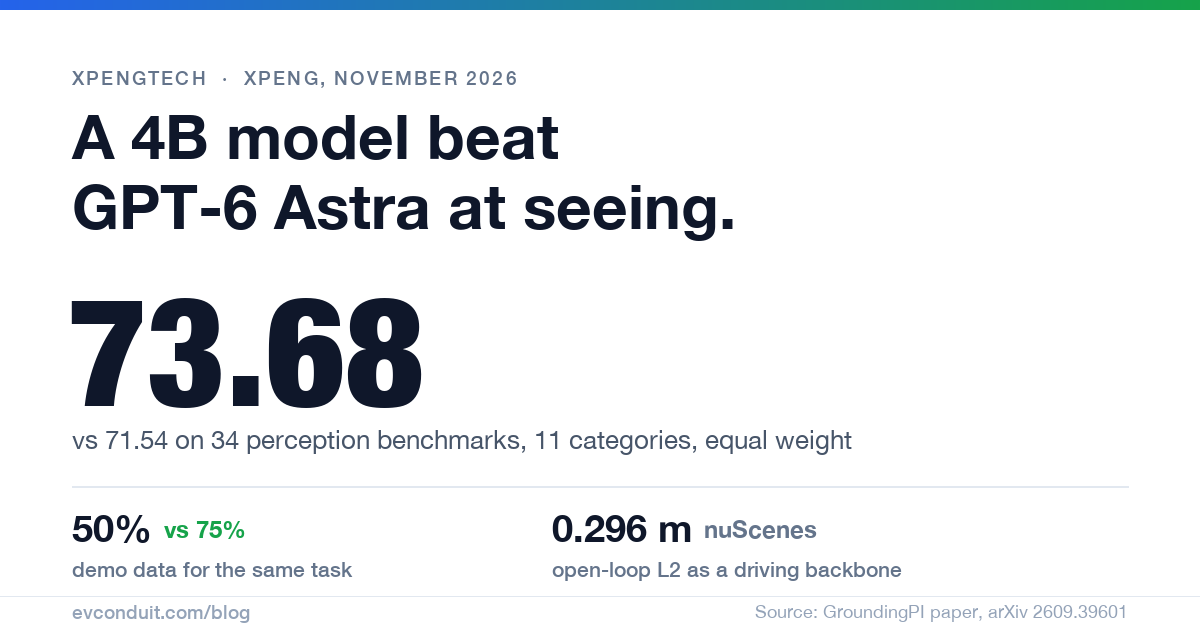
On 4 November XPeng announced GroundingPI, a 4-billion-parameter perception model that, it says, beat OpenAI's GPT-6 Astra across 34 public perception benchmarks — 73.68 to 71.54, averaged over 11 capability categories with equal weight, against 44 baselines.
There is a detail the announcement did not lead with: the work is not new this week. The paper went up on arXiv on 30 September, the weights landed on Hugging Face on 1 October, ModelScope followed on 14 October, and Hugging Face Daily Papers made it their #1 paper of the day that same week. By the time XPeng issued a corporate statement, the repository had been public for a month.
That is not a criticism — it is the most useful thing about the story. What XPeng announced on Tuesday was less a release than a repositioning: research that had been sitting quietly in the open, now being pointed at the company's public AI narrative.
What GroundingPI actually is
The name is doing work. Grounding is the perception task of deciding which object is meant and where exactly it is. PI is Physical Intelligence. Put together: a model that only does the seeing, and does not pretend to do the acting.
That is the design thesis. XPeng's argument — and the paper's opening — is that vision-language-action models and world-action models currently borrow perception from general-purpose VLM and video backbones, and those backbones are not good enough at precise localisation in clutter, at tiny objects, or at the speed closed-loop control demands. GroundingPI is a drop-in replacement for that specific part.
Three design choices follow from it:
- No action labels. Training uses pure perception data — no robot demonstrations with joint-action annotations — covering 11 capability categories including general detection, dense small objects, referring localisation, text region grounding, document layout and point localisation. The paper reports a staged recipe: multimodal and spatial pretraining, supervised fine-tuning, then reinforcement learning with GRPO.
- Points and boxes as tokens. GroundingPI emits coordinates as quantised values in a shared vocabulary rather than as a separate detection head, which is what lets one model cover detection, referring, pointing and OCR-style tasks in one format.
- System 1, not System 2. The company is explicit that this is the fast system's perceptual base, not a replacement for the general large model that handles planning and task understanding.
The author list reflects the ambition: XPeng with Peking University, the University of Hong Kong, UC Berkeley, Princeton, NUS, Tsinghua and HKUST (Guangzhou) — two dozen named authors, with Xianming Liu among them.
The number everyone will quote
73.68 versus 71.54. A 4B specialist beating a larger general model on perception is the expected shape of that result — you would be surprised if it lost. What is notable is the margin and the breadth: 34 benchmarks is not one tidy task, it is 11 categories of visual capability stitched into a single weighted score.
Two things make the comparison more defensible than the usual vendor benchmark:
- The evaluation uses
lmms-eval, the community evaluation harness, and the repository ships the full-suite evaluation workflows and task definitions. That is a materially better position than "trust our internal number." - The downstream experiments are the actual claim. A grounding score is a proxy. What a robot or a car cares about is what happens when the model is used as the visual backbone underneath an action policy.
Those numbers:
| Experiment | What GroundingPI did |
|---|---|
| RoboTwin 2.0 (manipulation) | Beat every mainstream backbone evaluated in all four out-of-distribution settings, by up to 24.8% relative to the strongest |
| RoboCasa-GR1 (manipulation) | Trained on 50% of the demonstrations, beat baselines trained on 75% |
| nuScenes (driving) | 0.296 m average open-loop L2 error as the visual backbone |
The claim with the commercial weight
Of those three, the second is the one that matters, and it is buried at the bottom of most coverage.
Humanoid and robot programmes are bottlenecked less by model architecture than by demonstration data — a human in a rig, driving a machine through a task, over and over. It is slow, expensive and does not scale the way web text scaled language models. A perception base that halves the demonstrations required for the same success rate attacks the unit economics of the whole enterprise, not just a leaderboard.
XPeng's explanation for why is mechanical rather than mystical: if the perception backbone already handles locating the object, the action policy does not have to learn localisation from the demonstration data — it can spend its capacity on the manipulation itself. The paper also flags a surprising secondary finding, that OCR is a catalyst for perceptual learning: text recognition in training appears to help the model learn general perceptual structure, not just text.
The detail XPeng's statement left out
The weights are open. The licence is not quite "open source" in the plain sense.
Original contributions are Apache 2.0, but the model package is licensed "apache-2.0-with-upstream-kimi-k3" — the VLM implementation is derived from Moonshot's Kimi K3, and that upstream licence travels with it. The repository's third-party notices spell this out properly, including the retained Kimi K3 licence file and the exact upstream commit.
This is not a scandal; building on an existing open VLM is how most open models are built, and documenting it clearly is the right behaviour. But it does mean the honest sentence is "XPeng open-sourced a grounding model built on Kimi K3," not "XPeng open-sourced its perception stack." The difference matters if you are a competitor reading the licence, or a reader deciding how much credit to hand out.
What it does not mean for your car
XPeng's own statement calls the work a scientific prototype. There is no production claim, no OTA date, no car-level benchmark, and no suggestion that anything in a G9L or L05 changes because of it.
The realistic path is indirect: if a grounding backbone like this ends up under XPeng's VLA stack, the improvement shows up as better localisation and cheaper training — not as a headline feature. The company has been building toward that stack for a year, folding its autonomous-driving and cockpit centres into a single general intelligence centre under Liu Xianming, and shipping VLA 2.0 into the IRON robot while the robotaxi programme moves from testing toward service.
Where to stay sceptical
- Open-loop L2 is not driving. A 0.296 m average error on nuScenes is a planning-proxy metric computed against recorded trajectories. It says nothing about closed-loop behaviour in traffic.
- Equal weighting across 11 categories is a choice. A composite score of 73.68 is only as meaningful as the weights behind it, and those weights are the authors'.
- The benchmark suite is public, the harness is now published, but no independent group has replicated the result yet. At the time of writing the GitHub repository sits at roughly 300 stars — this is a young project, not an established baseline.
- "Beats GPT-6 Astra" will travel further than the paper supports. The claim is about perception benchmarks. It is not a claim about general capability, and GPT-6 Astra is a much larger general-purpose model being scored on a specialist's home turf.
The bottom line
XPeng has built a small, specialised model that does one thing — deciding where things are — openly, with a clear account of what it is not. The leaderboard line is the marketing; the 50%-of-the-demonstrations result is the science; and the fact that it shipped to Hugging Face five weeks before the press release is the part that tells you what kind of company is doing this.
The open question is the one no benchmark answers: whether a perception base trained entirely without action labels holds up once it is underneath a production policy, in a car, in traffic. That is a 2027 question, and XPeng has at least made it checkable.
Sources: XPeng's 4 November 2026 announcement, with the primary material from the GroundingPI paper, project page, GitHub repository and Hugging Face model card; company framing and figures also reported by CnEVPost, 证券时报 and 第一电动. Benchmark figures are the authors' own; licence details from the repository's third-party notices. Not investment advice.
Enjoyed this? Get the next one direct.
New articles, or a daily / weekly digest — delivered to your inbox.