COMAC's CE-25A Spotted in Photos: Ten Ducted Fans, 19 Seats, No Announcement
Two photographs of a red-and-black aircraft marked CE-25A and B-0EFH circulated on Weibo on 28 October and became 'the national team's electric airliner'. The concept is real — COMAC showed a 19-seat, all-electric commuter as a model in 2023 — but the manufacturer has said nothing, no flight is confirmed, and the battery behind the claimed range has never been officially named.
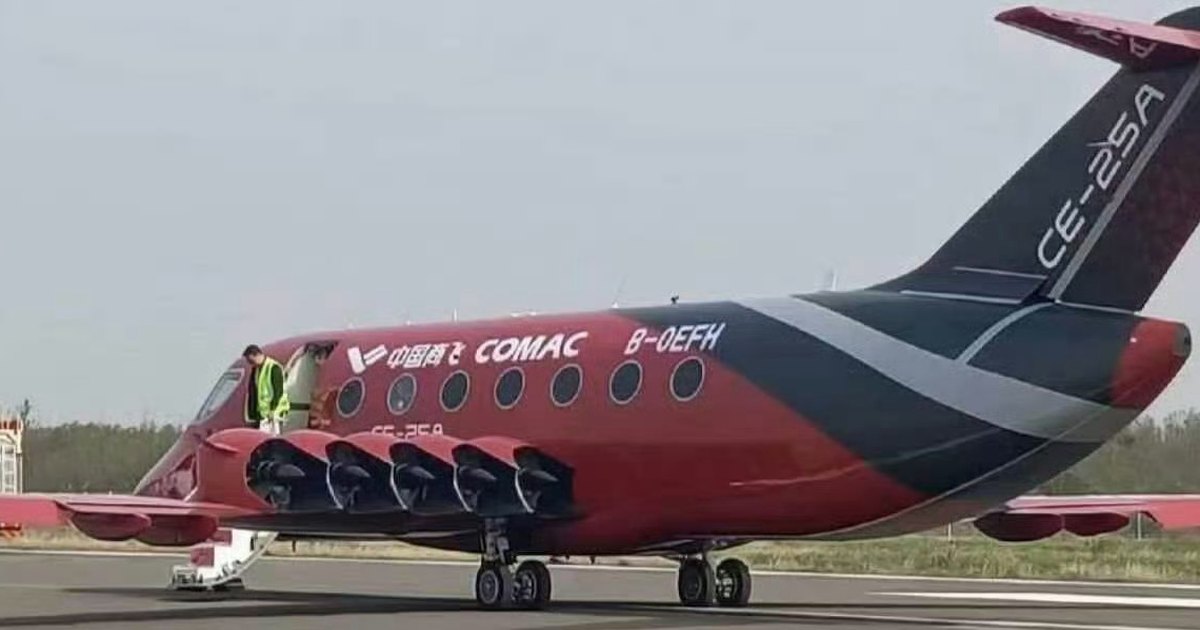
A red-and-black aircraft marked CE-25A and B-0EFH turned up on Weibo on 28 October, and by the evening it had become "the national team's electric airliner". The concept behind it is real — COMAC showed a 19-seat, all-electric commuter as a model at the 2023 Shanghai import expo — but almost everything the photographs add is unconfirmed: COMAC has said nothing, no flight has been announced, and the battery that the claimed 400–500 km range depends on has never been officially attached to this aircraft.
What was posted
The Weibo account 电车出海 (EV Goes Overseas) posted two photographs at 22:56 on 28 October with a short caption:
#国家队做的纯电客机来啦#
国产纯电客机CE-25A真机落地。
当还有人唱衰新能源汽车的时候,国产新能源飞机已经准备起飞。
Which translates as:
#The national team's all-electric airliner is here#
The domestically built all-electric airliner CE-25A has arrived in the metal.
While some people are still talking down new-energy vehicles, domestically built new-energy aircraft are already preparing to take off.
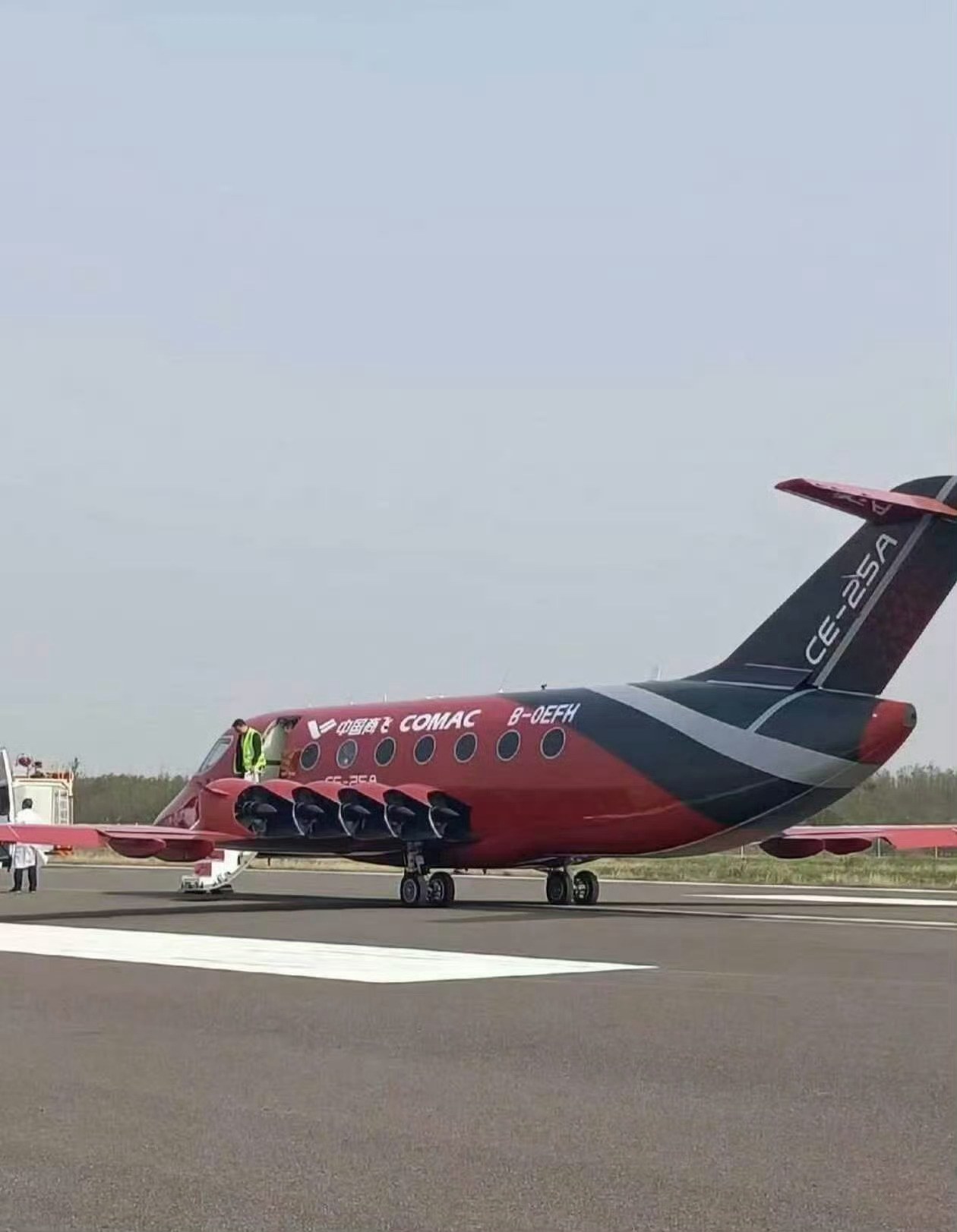
Photo: 电车出海, Weibo, 28 October 2026.
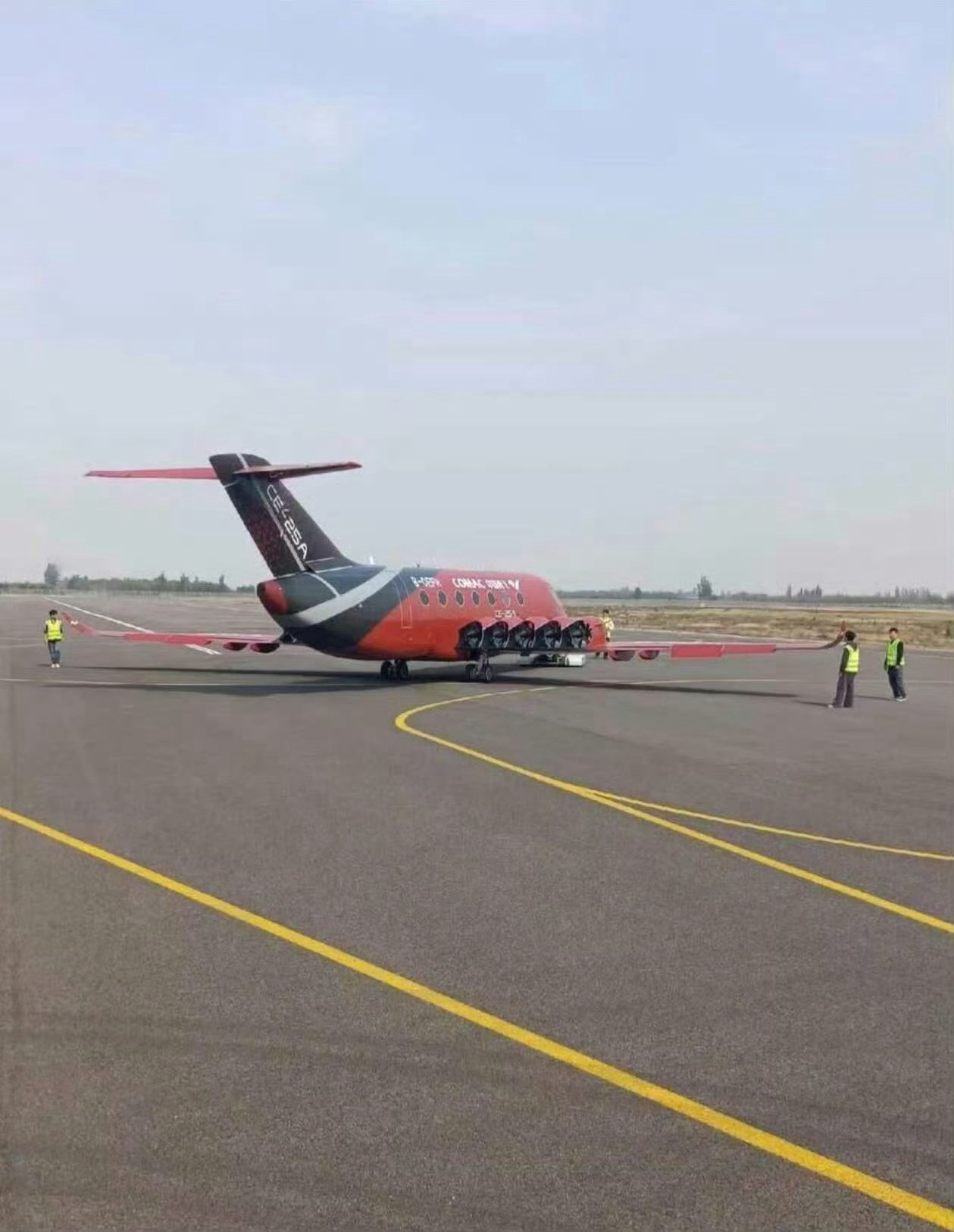
Photo: 电车出海, Weibo, 28 October 2026.
The photos show an aircraft in red and black with a silver cheatline, "中国商飞 COMAC" along the forward fuselage, "B-0EFH" behind the cabin windows and "CE-25A" on the vertical tail. It is a T-tail design, and along each side of the rear fuselage, below the window line, sits a row of five ducted fans — ten in all. People in hi-vis vests and a ground power cart stand beside it. Neither photograph shows the aircraft off the ground.
At the time of writing the post carried 19 likes, 7 reposts and 10 comments. It was not the first post of the day, and it was not the one that started the story.
How a photograph became an announcement
The earliest version I can find was posted at 09:41 the same morning by 瘦驼, a science writer, with two photographs and a joke:
有意思,路边捡的优盘里,有这么个奇怪的飞机,不知道真假。
"Interesting. In a USB stick I found by the roadside there's this strange aircraft. No idea if it's real."
That post carried 100 likes, 7 reposts and 24 comments by the time I read it. It is a joke about provenance, not a claim about the aircraft, and it is the only origin the photographs have: nothing in the coverage traces them to COMAC, to an airfield, or to anyone who says they took them.
At 16:43, the Weibo account of 解放日报 (Jiefang Daily) published a report crediting the aviation account 民航事儿. It described the CE-25A as a 19-seat new-energy electric short-haul commuter developed by COMAC, aimed at short-haul passenger transport and high-end business travel, with a range of 400–500 km and a maximum cruising speed of about 400 km/h. It noted that this places the aircraft in the regional short-haul market rather than against the C919 and C929, and that it was first shown as a model at the COMAC stand at the Shanghai import expo. It also said, plainly, that "there are rumours that the CE-25A has completed demonstrator-stage flight testing (so far unconfirmed)".
At 16:53 the car blogger 韩路 posted the same two photographs with the line that became the hashtag — "the national team's all-electric airliner is here" — and the only technical observation most of the coverage repeated: ten small ducted electric fans, "more than a dozen people", "over 400 km", performance "average" but "at least not PowerPoint". That post carried 995 likes, 72 reposts and 326 comments. 电车出海's evening post, the one this article started from, added the framing about people who talk down new-energy cars.
The story reached the English-language aviation press the same day. The War Zone reported the images and the 2023 concept, said its own examination with AI image-analysis models found no major indications that they were generated, and stressed that it could not establish that the imagery is legitimate. AeroTime could not verify them either, and could not completely rule out the use of AI.
What is actually known
The concept is not in doubt. COMAC presented the CE-25A as a model at the China International Import Expo in Shanghai in November 2023, described as a 19-seat all-electric commuter aircraft for short- and medium-distance passenger transport and business aviation. Published design figures were a cruise speed of about 400 km/h and a range of roughly 400–500 km, using distributed electric propulsion: instead of one or two large turboprops, the design uses ten electrically driven ducted fans.
The photographs are consistent with that design — same manufacturer, same designation, same 19-seat class, same ten-fan arrangement — and they show a full-sized aircraft rather than a model. If they are genuine, the programme has reached hardware, which is more than the 2023 concept promised.
Why the configuration matters: distributed electric propulsion spreads thrust across many small fans, which can bring redundancy (several motors can fail without losing the aircraft), lower noise, and shorter take-off and landing runs suitable for small general-aviation airfields. It also brings harder engineering problems: integrating many fans into the airframe, cooling the power electronics, controlling thrust across ten units, and — above all — carrying enough battery.
For scale, the closest conventional comparison is the Beechcraft 1900, a 19-seat twin turboprop with roughly 700 km of range and a cruise speed of about 520 km/h. The electric aircraft gives up speed and range for zero fuel burn, much lower noise and the ability to use shorter runways. On the routes it targets — short regional sectors, islands, business travel — that trade can make sense in a way it never would on a mainline jet.
What is not known
Whether the photos are genuine. No outlet has verified them. The War Zone's AI-image check found no strong signs of generation, but "no signs of AI" is not the same as provenance, and neither photograph carries any indication of where or when it was taken beyond what the poster says.
Whether it has flown. This is the claim that hardened fastest and is supported least. The Jiefang Daily report labelled the flight-test rumour unconfirmed even as it repeated it; The War Zone said there is no clear public confirmation that this particular aircraft has flown. COMAC's 2023 statements referred to flight-test work involving a scaled demonstrator, while the aircraft in the photographs is full-sized — which leaves open the possibility of a smaller, unseen aircraft that flew first. No photograph shows the CE-25A airborne.
Whether COMAC has said anything at all. Nothing in the coverage is attributed to COMAC: no press release, no official statement, no company post. The entire chain runs from an unattributed photograph to a media report to a social-media hashtag, and the manufacturer has stayed out of it.
What battery it carries. Several Weibo commentators asserted that the aircraft uses a 500 Wh/kg condensed-matter battery from 商飞时代 (COMAC Times), the COMAC–CATL joint venture. That is a strong lead, not a confirmed fact: neither COMAC nor CATL has said which cell the CE-25A flies with, and the installation has not been officially disclosed.
Where it sits in the programme. A technology demonstrator, a pre-production prototype and a certification aircraft are different things, and nothing publicly says which this is. There is no type certificate, no published certification basis, no timeline and no operator.
One more caution belongs here: Chinese commentary has already described the aircraft as being in ground taxi testing, and some of it asserts that the project had already completed flight testing of a scaled demonstrator. Neither claim traces to COMAC, and both go further than the photographs — which show, at most, an aircraft parked on an apron with ground equipment around it.
The battery is the whole question
Batteries are why this aircraft looks the way it does. Jet fuel carries roughly 12,000 Wh/kg; the best automotive lithium-ion cells are below 300 Wh/kg. Even the most ambitious aviation cells — CATL announced a condensed-matter battery in April 2023 with single-cell energy density of up to 500 Wh/kg, developed to aviation-grade standards — are an order of magnitude behind kerosene. And unlike fuel, a battery does not get lighter as the flight goes on: every kilogram of it is carried for the whole trip. That is the constraint behind the 400–500 km range and the 19-seat cabin. It is not a choice the designers made; it is the wall they are working against.
The industrial groundwork exists. In July 2023, 商飞时代(上海)航空有限公司 was established with COMAC, CATL and Shanghai Jiao Tong University Enterprise Development Group as shareholders, with a business scope including civil aircraft production and battery sales. CATL said in June 2025 that it was cooperating on a civil electric manned aircraft project under aviation-grade standards and testing. Its chairman had said earlier that the company was flight-testing a four-tonne aircraft, that commercial operation would need aircraft above eight tonnes — around the weight of a 19-seat commuter such as the Beech 1900 — and that applications were expected around 2027–2028.
None of that is a statement about the CE-25A. It is the reason the CE-25A is plausible.
Elsewhere in electric aviation
The CE-25A is not the first electric aeroplane of its size to leave the drawing board. On 12 August 2026, Heart Aerospace flew its X1 demonstrator at Plattsburgh International Airport in New York State: a 27-minute manned flight reaching 335 m, with a powertrain delivering more than one megawatt, on an FAA experimental certificate. With a 32.3 m wingspan, 23.2 m length and an all-up weight of about 11,340 kg, the company called it the largest battery-electric aircraft ever flown. That aircraft is a demonstrator for the hybrid-electric, 30-seat ES-30, which Heart expects to bring to market in 2031.
The X1 flew. The CE-25A, on today's evidence, has been photographed. That is the difference between the two programmes, and it is the difference that matters until COMAC says otherwise.
What to watch
- COMAC's own words. A press release, a rollout ceremony, an official first-flight announcement or a programme name would each move this from photographs to fact. Until one of them appears, the most important detail in the story is that the manufacturer is silent.
- First flight evidence. Not a caption and not a hashtag: a date, a place, a duration, and ideally an independent observer.
- The battery. If the aircraft does fly with CATL's 500 Wh/kg cell, that is a bigger story than the airframe. If it flies with something else, the numbers in this week's coverage are guesses.
- Certification. An electric commuter airliner will need a certification basis before it can carry passengers, and for distributed electric propulsion that is new ground for every regulator.
- The timeline. Heart expects its ES-30 in 2031. CATL has talked about 2027–2028. COMAC has committed to nothing, which is the honest state of the programme.
The original post
#国家队做的纯电客机来啦#
国产纯电客机CE-25A真机落地。
当还有人唱衰新能源汽车的时候,国产新能源飞机已经准备起飞。
Source: 电车出海 (Weibo, uid 7797864757), posted 28 October 2026 at 22:56 +0800; two photographs; 19 likes, 7 reposts and 10 comments when read on 29 October 2026. The story it reposts traces to 瘦驼's photographs that morning and to a 解放日报 report crediting 民航事儿, which itself described the flight-test claim as unconfirmed.
Sources: The War Zone · AeroTime · 解放日报's Weibo report · 瘦驼's photographs · 韩路's post · IT之家 on CATL's condensed-matter battery · Shanghai Securities News on 商飞时代 · electrive on Heart Aerospace's X1 · The original Weibo post