XPENG details G9L safety package: 16,000-tonne casting, 10 airbags, four-way redundancy
XPENG's G9L safety brief covers a 16,000-tonne front/rear mega-casting, up to 10 airbags, 192 crash tests, 150 km/h AEB and four-way backup for braking, drive, comms and unlocking.
XPENG has published a detailed safety brief for the G9L, the car it is taking to Europe, describing three layers of protection: passive safety, active safety and what the company calls aviation-grade redundancy. The post, from Weibo auto account 说车小祁, is a company-sourced summary rather than an independent test result, so treat the figures as XPENG's own claims until third-party ratings appear.
Passive safety: structure, airbags, crash volume
The headline claim is a 16,000-tonne front-and-rear integrated die-casting machine, which XPENG describes as the largest in the industry. Mega-casting replaces many welded parts with fewer, larger castings; the trade-off owners should understand is that a damaged casting is generally replaced rather than repaired, which affects repair cost and insurance even when the cabin is untouched.
Other claims in the post:
- Up to 10 airbags across the car.
- Designed to meet four global five-star safety standards, without naming which programmes.
- 192 crash tests completed in total.
- A full battery active-and-passive protection system fitted as standard across the range.
- A "720° seven-stage" combined water, land and air safety challenge, which XPENG says is an industry first for a single vehicle.
That last item is a marketing construct, not a regulatory test. The four five-star claims and the 192-test figure are the ones worth watching for confirmation from Euro NCAP or equivalent bodies.
Active safety: 150 km/h AEB and blowout control
The second layer is about avoiding the crash rather than surviving it. XPENG quotes an AEB (automatic emergency braking) operating ceiling of 150 km/h, meaning the system is claimed to still brake for a suddenly stopping lead vehicle at motorway speed. Many systems cap out well below that, so the number is meaningful if it holds in independent testing.
The post also lists:
- Full-scenario tyre blowout stability control, claimed to hold a single front wheel stable at 180 km/h after a blowout.
- A driver-incapacitation assist function, intended to intervene before a medical event becomes a collision.
Blowout control at that speed is a strong claim and one of the harder scenarios to verify outside a proving ground.
Aviation-grade redundancy: four systems with backups
The top layer is what XPENG calls a four-fold aviation-grade safety redundancy design, which it says is an industry first. Four critical systems each carry a backup:
- Braking
- Drive
- Communication
- Unlocking
The claim is that failure of any single system does not prevent the car being used safely. Redundancy of this kind is standard practice in aviation and increasingly discussed in Chinese EVs as steer-by-wire and brake-by-wire replace mechanical linkages, but "industry first" is XPENG's framing, not an established fact.
What this means for owners
For Australian owners, the practical read is that this is a specification and engineering brief, not a software rollout, so there is no OTA timing question here. What matters is which of these systems are standard on the variants that reach this market. XPENG says the battery protection system is standard across the range; it does not say the same for the 10-airbag count, and airbag content often varies by trim and market.
Two things to watch. First, independent crash results: the four five-star claims are only as good as the programmes that confirm them, and Euro NCAP results for the G9L would be the clearest signal for right-hand-drive buyers. Second, repair economics. A 16,000-tonne front-and-rear casting is excellent for stiffness and packaging, but ask your insurer how they assess it before assuming premiums will match a conventionally built SUV.
The AEB ceiling and blowout control are the claims most likely to be tested by owners in daily driving, on highways and on regional roads. Until independent testing exists, treat the 150 km/h and 180 km/h figures as manufacturer targets.
Sources
Photos from the source posts
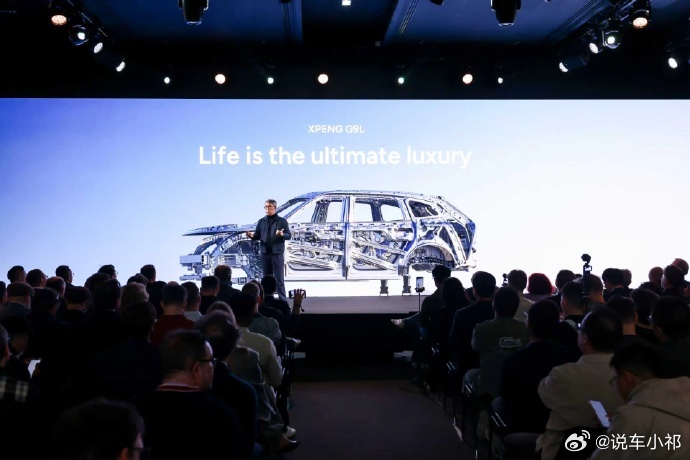 Photo: 说车小祁 on Weibo — original post
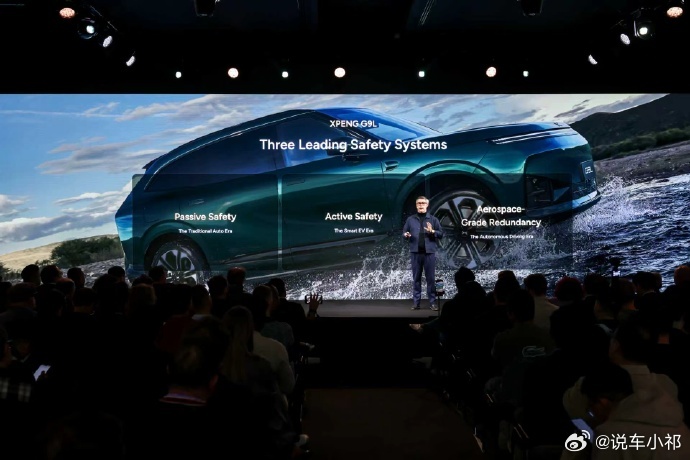 Photo: 说车小祁 on Weibo — original post
Enjoyed this? Get the next one direct.
New articles, or a daily / weekly digest — delivered to your inbox.