Liu Xianming on XOS 6.3.0: XPeng's Physical AI Upgrade, in Full
XPeng VP Liu Xianming's full article on XOS 6.3.0, translated — InfiniVLA's 30-second history, X-Foresight's 6-second prediction, Flow Matching and MoT — plus 电动知士大雨's reading of what the dual Orin-X distillation means for Max owners, and where that rollout stands.
XPeng's XOS 6.3.0 update arrived with a long technical article from Liu Xianming, XPeng's Vice President and head of the General Intelligent Center — and this post contains two things: the reading of it by Chinese auto-tech channel 电动知士大雨, which focuses on what the dual Orin-X distillation means for Max owners, and then a full translation of Liu Xianming's original article, which XPeng published on its own site.
Part 1 — What the article says about dual Orin-X (电动知士大雨)
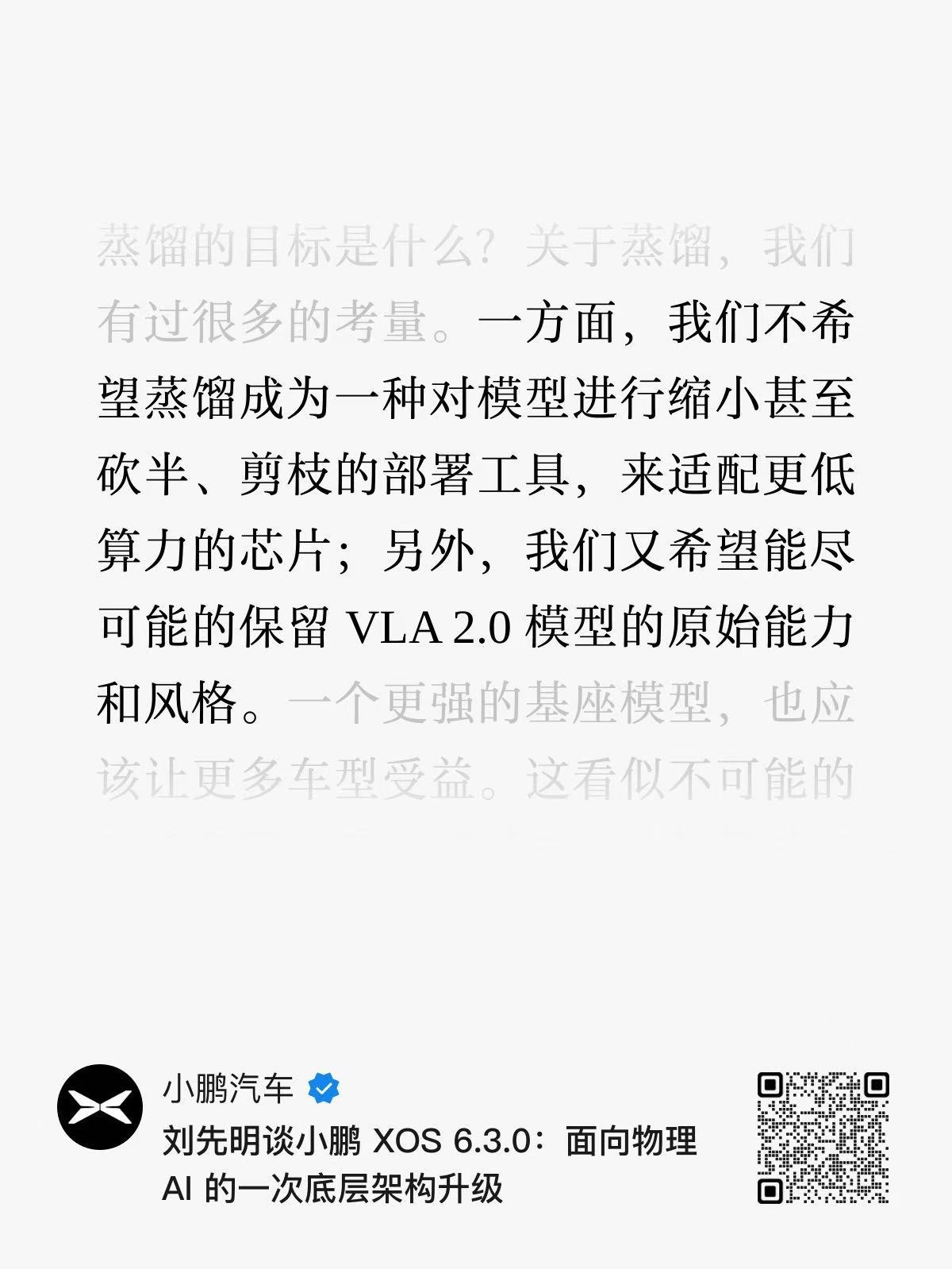
In his own words, the part he paid most attention to is the dual Orin X distillation, because it answers two questions: what work is needed to deploy VLA 2.0 on a low-compute platform, and how to reduce compute cost while keeping as much model capability as possible.
The sentence he singles out: dual Orin distillation involves cross-platform / cross-model-architecture work and requires more thorough optimisation down to the underlying level, even the operator level. In his reading, that is very likely a major reason the dual Orin X version needs more time — beyond distillation training, XPeng also has to complete adaptation for that specific hardware.
He breaks the disclosed work into four parts:
- Reconstructing the heaviest vision computation. The ViT was rebuilt from the ground up, building on work such as HybridViT and TuringViT, using "learning-based compression" to cut compute while preserving as much downstream model capacity as possible. On a low-compute platform, how much vision processing consumes determines what is left for everything else — so the student model's architecture has to be adjusted before distillation.
- Optimising how the model runs on the chip. Compiler, deployment and operator optimisation all serve hardware utilisation. Because dual Orin X is cross-platform and cross-architecture, the optimisation has to go deeper: retaining capability while still running well on an older platform.
- Improving both teacher and student. A stronger teacher gives richer learning signals; the student needs enough capacity and the right architecture to absorb them. XPeng is therefore also raising the student's base capability before distillation — so the outcome depends on teacher, student and training method together. He notes that XPeng has not disclosed how much of the 6.3.0 base model's long-temporal and prediction capability survives into the dual Orin X build, and that based on past cases (V14 lite, NWM) he expects most base capability to be similar, with possible small differences in long-tail scenarios, response latency and perception range.
- Prioritising training on high-frequency scenarios. Ultra and Max have an explicit capability split — Ultra pushes scenario coverage, long-tail handling and cross-region generalisation towards L4; Max focuses on commuting and daily use, so data selection and distribution push limited resources at those high-frequency scenes. That is a deliberate trade-off between versions, not just a hardware difference.
He closes with a comparison to another brand's moment: in their owner groups, NIO's long-time users once queued up to "apologise from afar" to William Li. His question is whether, after the dual Orin-X rollout, XPeng will earn the same recognition from its long-standing Max owners.
Part 2 — The original article, translated in full
What follows is a translation of XPeng's official article, "Liu Xianming on XPeng XOS 6.3.0: an underlying architecture upgrade for physical AI", published on xiaopeng.com on 15 September 2026. All views, figures and technical claims are XPeng's and Liu Xianming's.
What physical AI has to solve is understanding a world that keeps changing, and acting within it. For an intelligent car, that means the model must not only read the road in front of it, but remember what just happened, judge what may happen next, and then act in time.
This upgrade of the second-generation VLA is built around that core goal: bring time into the model, widen the capability boundary under limited on-board compute, and then — through architecture optimisation and distillation — bring those capabilities to more models. XOS 6.3.0 is a concentrated landing of this model capability, and a milestone in XPeng's long-term construction of a physical AI technology system.
1. Starting from the constraints of the physical world, upgrading the underlying architecture
Since 2024 we have pushed a single core technical route: through underlying architecture innovation, improving the model's ability to understand the world, make decisions and execute actions. As the model entered more real scenarios, some problems became clearer: without historical information, a model struggles to understand change; without future prediction, decisions lag; without the ability to express multiple possibilities, choices in complex scenes are limited. These problems have to be solved inside the model itself.
Physical AI also has clear boundaries. The compute, memory and power of on-board chips are limited, inference must meet latency requirements, and the system must obey safety and regulatory constraints. Larger models, longer context and richer prediction all ultimately have to run inside those conditions.
So we design model architecture, chip, compiler and deployment together: which information is worth keeping, which computation can be reused, and which capabilities model capacity should be allocated to. The architecture design of physical AI has to answer how limited compute produces stronger, deployable intelligence.
2. Letting the model understand the past, respond to the present and reason about the future
A single image can tell a model "there is a person here", but it struggles to explain where that person came from and where they are going. Much of the information driving requires lives in continuous change. The key upgrade of XOS 6.3.0 is to let the past, present and future all take part in judgement.
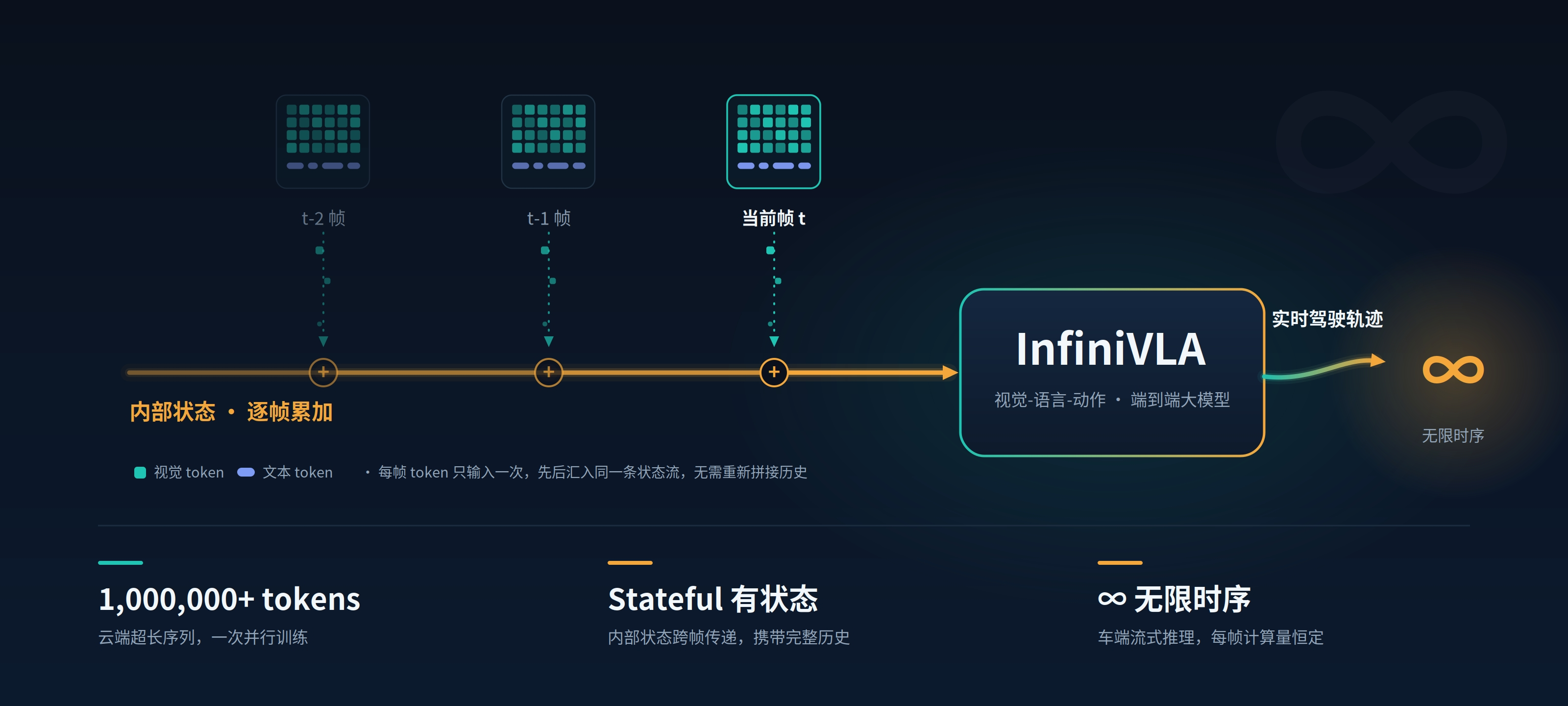
InfiniVLA: historical information keeps participating in judgement. The value of a long temporal sequence is keeping the context that is useful for the current decision — understanding a turn that is not yet complete, or judging a traffic participant briefly occluded, often requires looking back at how things changed. InfiniVLA lets historical visual information keep participating in the current judgement, handling longer physical-world context. In this on-board deployment XPeng chose a 30-second historical context, trading effective memory against compute cost. With streaming autoregressive inference, the model continuously receives observations, reasons and outputs actions, so processing keeps up with the scene and continuous actions get fuller contextual support. Given compute limits, InfiniVLA also introduces a caching mechanism that achieves an almost unlimited temporal memory capability without greatly increasing compute consumption.
X-Foresight: bringing future change into current decisions. Introducing the time dimension requires not only understanding the past but looking forward, predicting the changes the world is about to undergo, and responding more effectively and safely. The X-Foresight world model predicts future scenes from changes in vehicle position, speed and environment, so current decisions can refer to what may happen next — "a good physical AI system must be able to avoid falling into long-tail scenarios through prediction of the future." The prediction horizon also has to serve the task: the on-board solution chooses 6-second future prediction, concentrating resources in the time range closely tied to the current driving decision. XPeng introduced X-Foresight to the academic community at CVPR in June this year, and completed its mass-production landing in this OTA.
Flow Matching: expressing multiple reasonable actions. Real roads often allow several reasonable choices — slow and wait, or take a suitable detour — and those choices correspond to different trajectory distributions. Squeezing them into one "average answer" may fail to express any complete, reasonable action. The Flow Matching Head conditions on a long-temporal driving representation fusing vision, navigation and vehicle state, and through a learned vector field transforms noise into action trajectories. That generative approach can fit multi-peak distributions, expressing different driving intentions and trajectory choices. In training, feedback on safety, efficiency, comfort and compliance is combined with reinforcement learning to optimise the policy.
MoT: expanding model capacity under limited compute. MoT (Mixture of Transformers) uses expert division of labour so different scenarios are carried by the corresponding experts; visual and text information jointly guide scenario switching. It reuses visual information and keeps long-term memory continuous, so important context survives task switching. XPeng scales the model to hold more complex relationships and support more scenarios and stronger generalisation — but parameter count has to work together with architecture, data and compute-utilisation efficiency to become real capability.
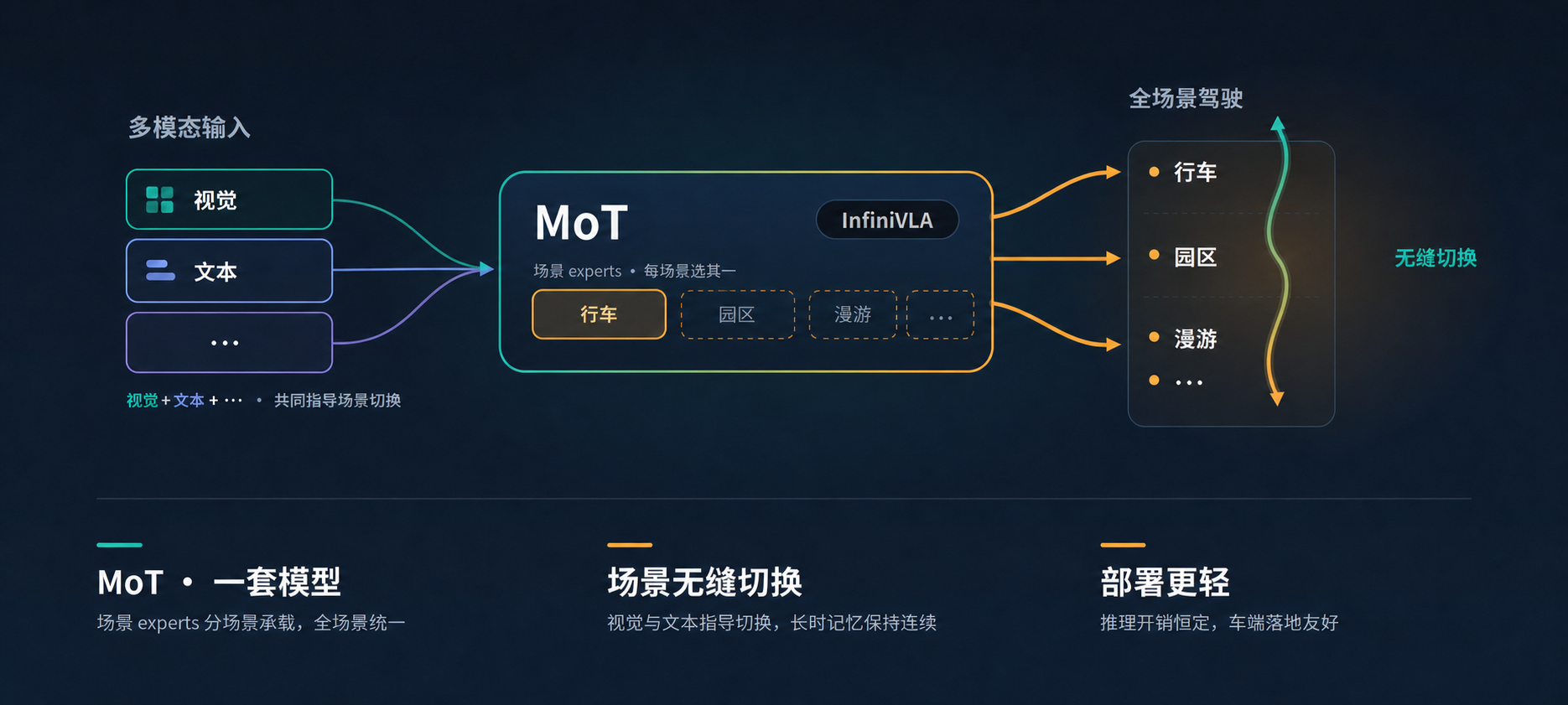
Together these technologies establish the model's temporal capability: InfiniVLA keeps the past, streaming inference follows the present, X-Foresight predicts the future, Flow Matching expresses multiple possible actions, and MoT provides more effective capacity and division of labour. XPeng adds that strengthening the model's understanding of time, and its capacity, produced safer and more efficient driving behaviour.
3. Max distillation: redesigning capability transfer around compute constraints
What is the goal of distillation? XPeng is explicit about the tension: "we do not want distillation to become a deployment tool that shrinks, halves or prunes the model to fit lower-compute chips", while still wanting to retain as much of VLA 2.0's original capability and style as possible — because a stronger base model should benefit more models. That contradiction, the article argues, can only be solved through underlying architecture upgrades and technical breakthroughs, "not crude one-size-fits-all cuts".
Several key technical problems had to be solved:
First, the student model has to be able to take on the teacher's capability — and run it efficiently on the target chip. The approach starts with the student's architecture: compute resources inside the model were redistributed around the Max compute bottleneck, and the heaviest part, the ViT, was completely reconstructed. Building on visual architecture work such as HybridViT and TuringViT, XPeng uses "learning-based compression" to reduce effective compute, combined with compiler and deployment optimisation to raise hardware utilisation, retaining as much of the model's "brain" capacity as possible. The point is that the student model has a higher capability starting point before it receives distillation.
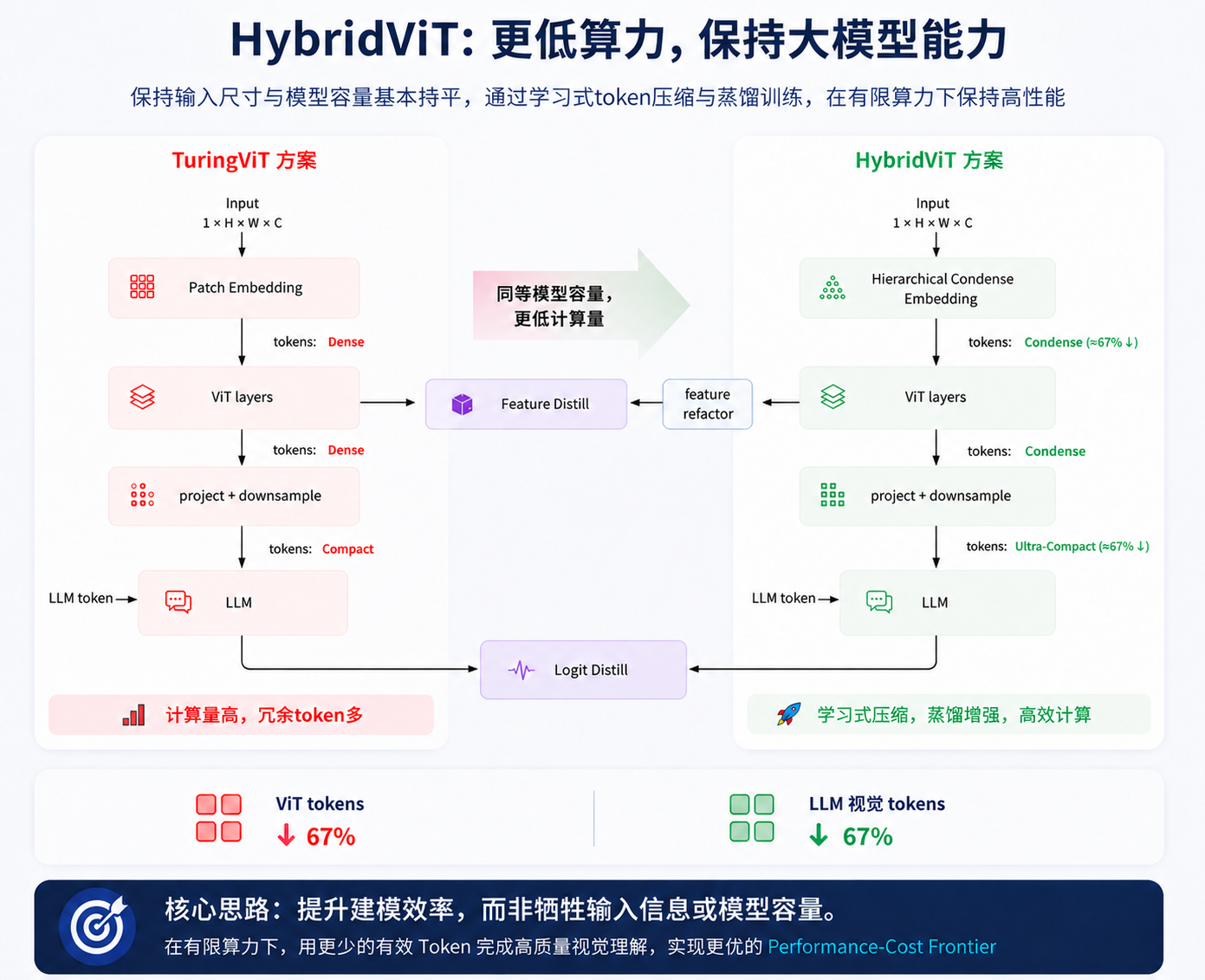
Distillation also depends on two further conditions: a sufficiently strong teacher model, providing richer learning signals, and a suitable data distribution, determining what the student learns and whether it covers the target scenarios.
Max distillation is supported by four pieces of work: redoing the architecture for the chip, continuously strengthening the teacher model, raising the student model's base capability, and optimising the quality and distribution of training data.
Ultra and Max have different emphases. Ultra takes evolving towards L4 as its long-term goal, continuously expanding scenario coverage, long-tail handling and cross-region generalisation. Max focuses on commuting and daily use, and prioritises limited resources on those high-frequency scenarios in data selection and training. The two share technical accumulation but make trade-offs according to their own compute conditions and product goals.
Where the rollout stands: Max distillation on the single-Turing platform has landed. The distilled version for the dual Orin X platform is in progress — and because it involves cross-platform / cross-model-architecture distillation, the technical challenge is greater, requiring more thorough optimisation "down to the underlying level and even the operator level". XPeng says it has recently made breakthrough progress and begun internal testing. Both single-Turing and dual Orin distilled VLA Lite versions will keep improving as the base model improves.
4. From one OTA towards a sustainably evolving physical AI system
Behind a model upgrade is infrastructure that brings data into training, validates the model, and deploys capability into products. Four elements:
- Joint chip and model optimisation, so capability actually lands on the car: the chip sets the compute conditions, the model decides how they are used, and the compiler and deployment chain determine runtime efficiency.
- Data infrastructure, summarised as "quantity × quality × distribution": scale provides coverage, quality affects learning, distribution decides which scenarios are learned properly.
- Closed-loop simulation, because real-world feedback is expensive and low-frequency scenarios are hard to repeat; simulation makes scenarios repeatable and tests behaviour across vehicle models and weather.
- Extending beyond cars: XPeng has explored using the same models to control both cars and robots, and says it has successfully migrated this physical AI system to XPeng Group's robots, achieving a high degree of reuse at the underlying level.
The article closes on XPeng's intent: starting from intelligent cars, building reusable, verifiable and sustainably iterable underlying capability, then letting it support more products — with XOS 6.3.0 as one concrete step, and the aim of bringing this system across XPeng's full product line.
Sources: 电动知士大雨 on Weibo (analysis, translated); Liu Xianming's original article on xiaopeng.com (translated in full, with XPeng's diagrams). All technical claims belong to XPeng and Liu Xianming; this post is a translation and summary with attribution.
Enjoyed this? Get the next one direct.
New articles, or a daily / weekly digest — delivered to your inbox.