He Xiaopeng Spent the Q3 Call Announcing Next Week's AI Day
XPeng's earnings call promised 100,000 overseas sales this year, robots in its stores by March, a Robotaxi export business in 2027 and a 2027 EU licence for urban assisted driving - four dates in thirty-five minutes, a week before the company's own AI Day. The export maths says the Q4 target only needs to hold October's rate, and the EU claim is narrower than the cards made it sound.
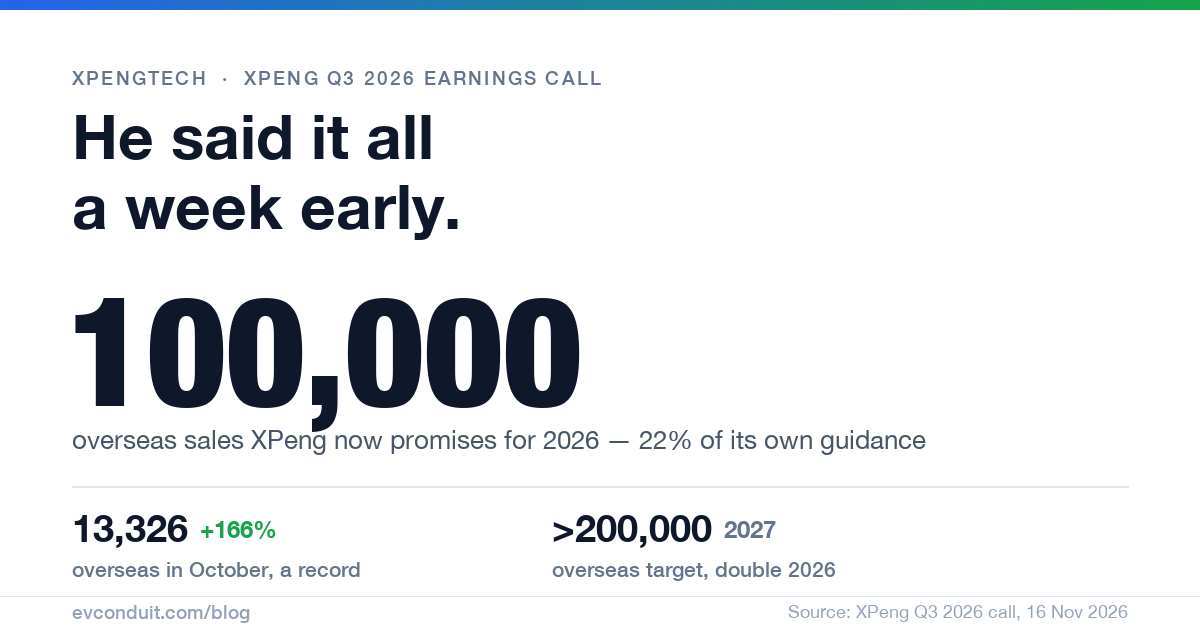
A Weibo account called 托马斯电火车 — "Thomas the Electric Train" — posted six screenshots from XPeng's third-quarter earnings call on Monday night and one line of commentary: "Feels like Rep. He talked a bit too much on tonight's investor call. A lot of this was meant to come out gradually at next week's AI Day." ("Rep. He" is He Xiaopeng, a National People's Congress deputy as well as chairman and CEO.)
By the next morning the post had 272 likes and 46 comments, which for a finance-adjacent account is a lot. The screenshots explain why. Between 20:38 and 21:13 Beijing time, five outlets — 第一财经, 人民财讯 (the Securities Times wire), 36Kr, 新浪财经 and 华尔街见闻 — each pulled a different forward promise out of the same call. None of them appeared in the results release XPeng published that morning.
Read together, the six cards are not a results wrap. They are a calendar.
What the call put on the record
| Commitment | Horizon | Card |
|---|---|---|
| Overseas sales above 40,000 | Q4 2026 | 华尔街见闻 |
| Full-year overseas sales above 100,000, a first | 2026 | 华尔街见闻 |
| Overseas sales more than double 2026 | 2027 | 华尔街见闻 |
| More than 1,000 overseas stores | 2027 | 华尔街见闻 |
| First mass-produced IRON robots into selected stores | Q1 2027 | 人民财讯 / 新浪财经 |
| Latest IRON shown publicly at Tech Day and the Guangzhou auto show | this month | 人民财讯 |
| IRON launched to external commercial customers | Q2 2027 | 人民财讯 / 新浪财经 |
| First-batch EU regulatory approval for urban assisted driving | 2027 | 人民财讯 (证券时报) |
| Turnkey Robotaxi solution exported to global partners | 2027 | 36Kr (蓝鲸) |
Those sentences rest on a quarter that was itself a record: 118,390 deliveries, RMB 24.28bn of revenue, an 18.9% gross margin with automotive margin at 13.1%, RMB 45.41bn of cash, and guidance of 169,000 to 174,000 vehicles for the current quarter. The results were the least interesting thing said on the call.
The overseas number is smaller than it sounds
He gave the export business four numbers in one answer: Q4 overseas sales above 40,000; full-year 2026 above 100,000, the first time; 2027 more than double 2026; and more than 1,000 overseas stores by the end of 2027. He also said October's overseas volume was 13,000, up 166% year on year and a record.
XPeng's own monthly report puts October at 13,326 overseas vehicles inside a 50,237 month. Do the arithmetic on the Q4 target: 40,000 split three ways is 13,333 a month. October was 13,326. The commitment is to hold October's run rate through the rest of the year — an increase of seven vehicles a month, or 0.05%. That is not a stretch target dressed up as one. It is a company telling analysts it expects the export line to sit at its October level rather than climb.
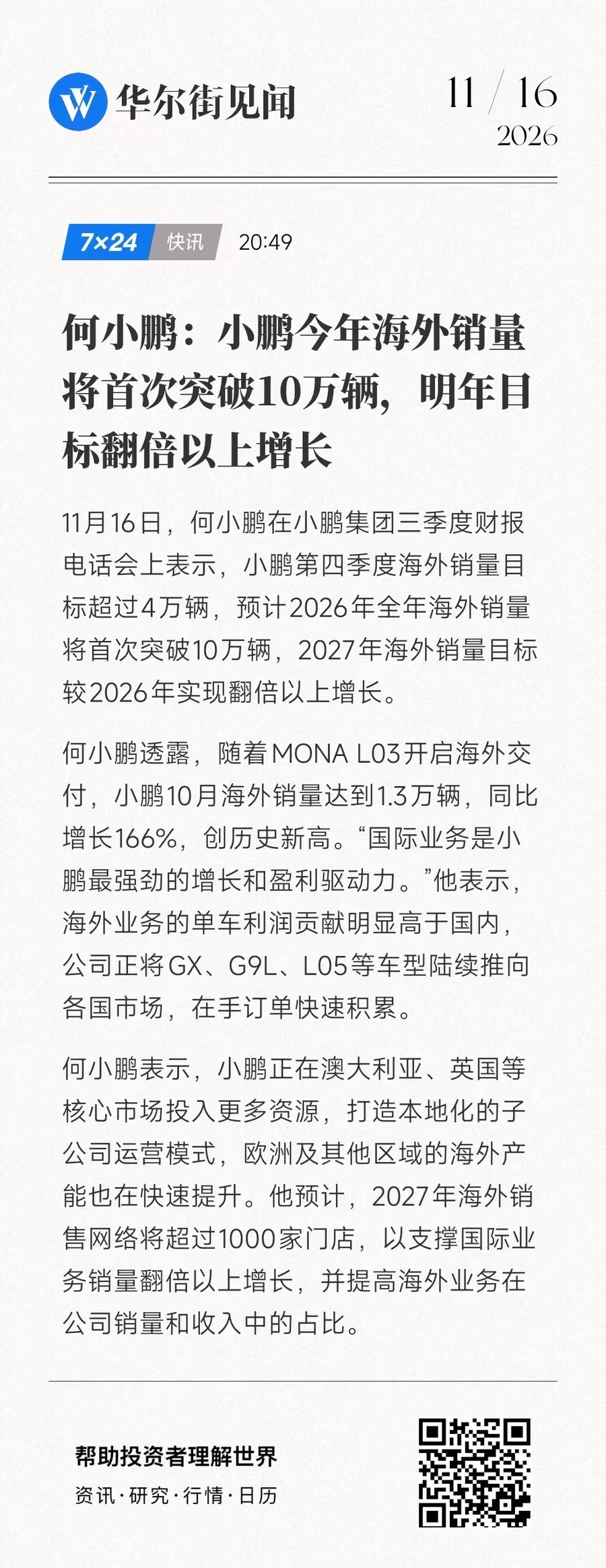
The Wallstreetcn 7×24 card, 16 November 20:49, carrying the export targets and the October figure. Image: 华尔街见闻 (Weibo).
The 100,000 annual figure is the more consequential one, because it is a mix statement rather than a volume statement. XPeng delivered 62,682 cars in Q1, 103,295 in Q2 and 118,390 in Q3 — 284,367 in nine months. Its own Q4 guidance takes the full year to 453,000–458,000. A hundred thousand exports is therefore 21.8% to 22.1% of the year: roughly one car in five sold outside China.
The 2027 line, "more than double", lands at 200,000-plus. That is the floor of what president Wang Fengying said in Paris in October, when she put the 2027 export target at 200,000 to 300,000. The call restated the bottom of the range, not the top.
He also gave the commercial reason, the one that reaches the P&L: per-vehicle profit overseas is "clearly higher" than in China. On a 13.1% automotive gross margin, mix matters more than volume.
Two markets were named — Australia and the UK — where XPeng says it is putting more resources into a localised subsidiary operating model, with overseas capacity in Europe and elsewhere "rising quickly". The cards do not say whether that replaces an existing distributor arrangement in either market. Both are right-hand-drive markets, which is the part Australian owners will notice.
A robot with a shop floor and two verbs
The IRON commitment came in two halves: in Q1 2027 the first mass-produced robots enter selected XPeng stores, and in Q2 2027 XPeng launches IRON to external commercial customers.
The two cards covering this disagree on one verb, and the difference is money. 证券时报 wrote that the store deployment begins 商用 — commercial use. 新浪财经 wrote 试用 — trial. Same plan, one card calling it revenue and the other calling it a test. The safer reading is the sequence both agree on: stores first, external sales second, with Q2 as the date that matters.
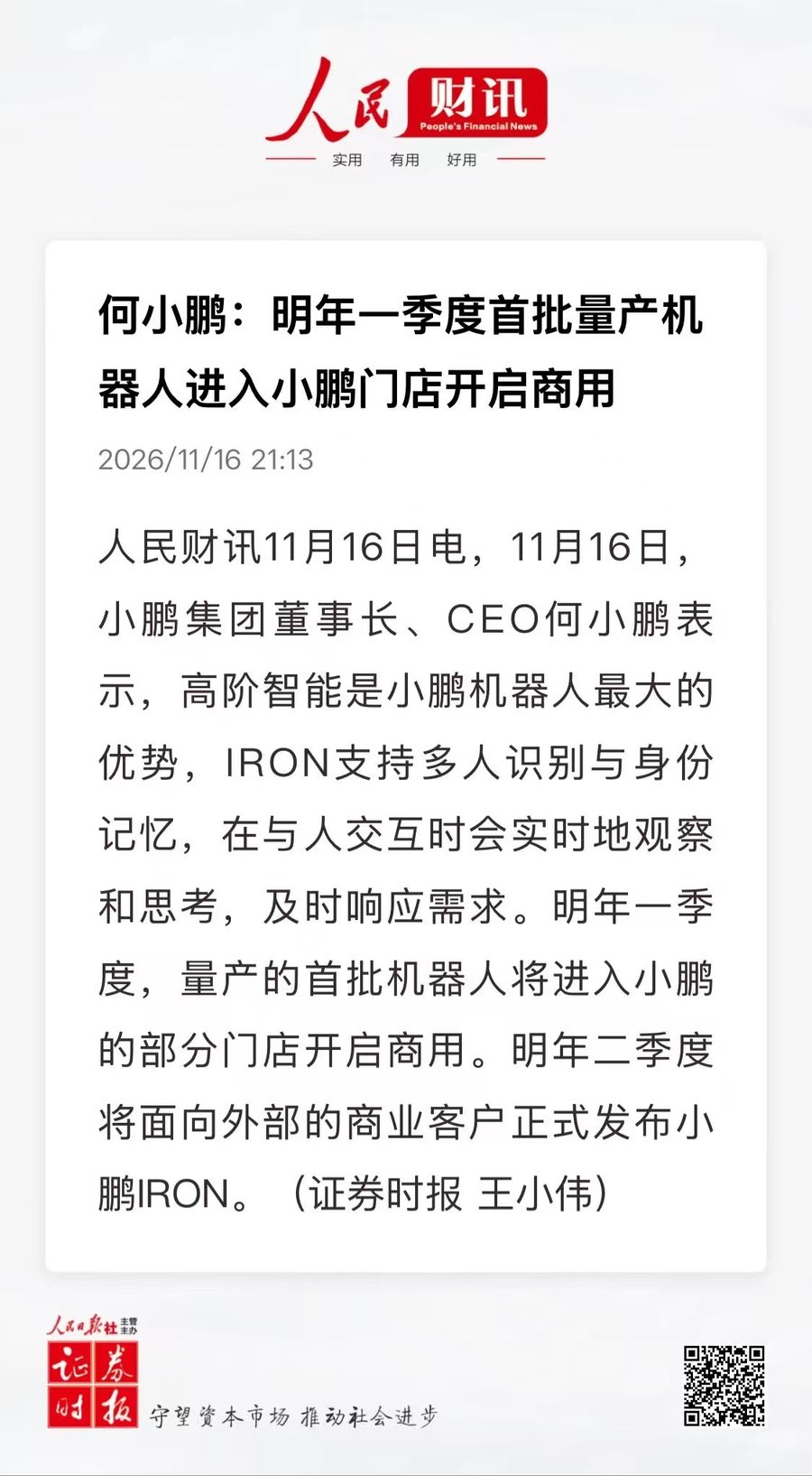
The 人民财讯 card, 21:13 Beijing — the version that says 商用, commercial use. Image: 人民财讯 / 证券时报 (Weibo).
What He said about the moat is the interesting part, and it is not the model. Asked what protects XPeng in humanoids, he listed the hardware itself, commercialisation at scale, manufacturing and sales capability, and high-quality, diverse data. That is a carmaker's answer, and it is the argument that XPeng can build a robot more cheaply than a robotics startup and sell it through its own retail network.
The capability claims on the cards — multi-person recognition, identity memory, real-time observation and response — are the ones XPeng has been making since IRON's earlier showings. What is new is the commercial timetable, and a public debut for the latest version at Tech Day next week and at the Guangzhou auto show.
Robotaxi: October's licence, next year's export
The licence is not news. On 26 October Guangzhou granted XPeng the intelligent-connected-vehicle demonstration-operation qualification for L4 Robotaxis across the whole municipality. What the call added was the business model around it. The service has its brand — 小鹏悠游, XPENG YOYO — a Q4 plan to "polish a replicable product and service system" in Guangzhou, and a 2027 plan to export "the complete solution to global partners".
That is supplier language, not operator language. It describes selling a Robotaxi system — vehicle, stack, service design — to somebody else who runs the fleet, the way XPeng already sells technical R&D services to a car manufacturer at a margin near 75%, against roughly 13% on cars. Whether that is easier than operating rides abroad is the open question. XPeng named no partner, no price and no market.
Europe: the word the Yicai card dropped
The 2027 European claim is the one to read with the original text in hand. 证券时报's version is precise: "hopes to obtain the EU's first batch of autonomous-driving regulatory licences in 2027, and be first to land urban intelligent assisted driving in Europe" — 城区智能辅助驾驶, urban assisted driving. That is a Level 2 system. Not a Robotaxi, not L3.
第一财经's card shortened it to "the EU's first batch of autonomous-driving regulatory licences", and its body to "land in Europe first". The qualifier that limits the claim to assisted driving disappeared in the compression, and with it the size of the achievement.
The date, though, is not arbitrary, and this is the part the cards miss entirely. Europe's approval route for any system that steers and accelerates the car is UN Regulation No. 171 on Driver Control Assistance Systems, and its Series 02 amendments — the ones that, from 2027, permit assist systems to suggest and initiate manoeuvres in urban traffic for the first time — are what makes urban assistance approvable at all. BMW said on 2 November that it expects approval in early 2027 and will launch urban Level 2 in Germany during the year.
So XPeng's "2027, first batch" is tracking the regulation's own calendar. The technology is not the gate; XPeng's urban assistance already ships in China. The gate is a type approval in a market where it sells, and in that queue BMW, Mercedes and the Chinese entrants will all be standing.
Which is why He framed VLA and VLM the way he did: as something that builds a differentiated position globally, brings higher volume and higher average selling prices, and makes XPeng a better global technology brand. Those are pricing and positioning claims. They are not claims about being first to drive themselves.
What is left for AI Day
Nothing improper happened on the call. An earnings call is public and on the record, the right venue for forward guidance, and Chinese disclosure rules push listed companies to give material information to all investors at once. But a company that stages its news had just spent the week's headlines in thirty-five minutes: six cards from five outlets, all live before the call ended.
The AI Day deck now has less to announce than it did on Monday morning. What remains is demonstration and detail — how VLA and VLM fit together, what the new IRON can do on a stage, what the Guangzhou stand shows. A week ago those were the headline items.
What to check
Three dates are now falsifiable, which is more than most calls offer.
- January's delivery report — Q4 overseas above 40,000. On October's rate it only needs to hold. A miss would mean October was a pull-forward.
- End of Q1 2027 — IRON in stores. Watch whether the units are staffed demos or customer-facing sales, because the two cards disagree.
- 2027 — the EU approval. The DCAS Series 02 window is real; the question is which market and which model get it first.
What the call did not give: the price of a robot, the unit economics of a Robotaxi ride, an overseas margin percentage, or the name of a single partner. It gave dates. Dates are cheap and checkable, and this company has just made a habit of handing them out early.
Source: 托马斯电火车 (Weibo, 16 November 2026) and the six outlet cards it attached — 第一财经, 人民财讯/证券时报, 36Kr, 新浪财经 and 华尔街见闻 — with UN R171 DCAS Series 02 context from electrive's report on BMW, 2 November 2026. Translated & adapted for XPENGTech.
Enjoyed this? Get the next one direct.
New articles, or a daily / weekly digest — delivered to your inbox.