A ¥123,800 SUV Won a Powertrain Award. It Won It on Cost.
XPeng's oil-cooled, mixed silicon/silicon-carbide e-drive has taken a place in China's 2026 'China Heart' top-ten powertrain list, and it is standard on the MONA L03 and L05 - cars from 123,800 yuan. The award rests on two numbers that get quoted interchangeably: 98.7% inverter efficiency and 92.3% for the whole e-drive, both on XPeng's own CLTC figures. What a 10.1 kWh/100 km media test is worth in money, and what the car's own spec sheet does not say.
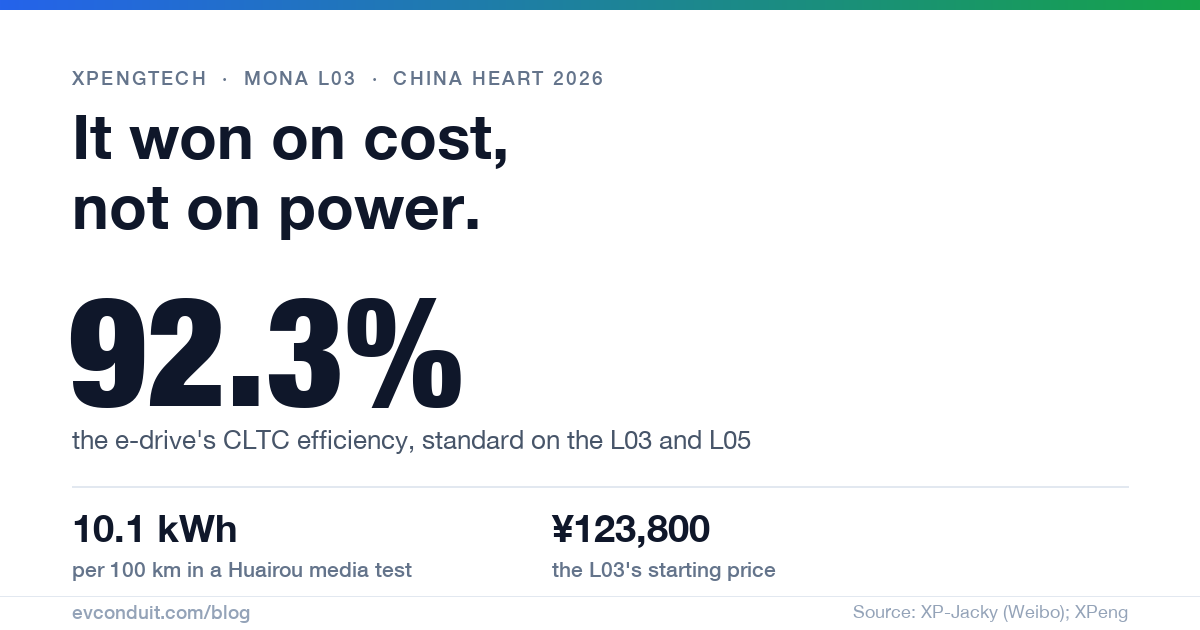
A car that starts at ¥123,800 has just won one of China's more closely watched powertrain awards, and the number it won on is not a power figure. It is an efficiency one.
The announcement came from XP-Jacky, XPeng's vice president in charge of powertrains, who wrote it up on Weibo on 11 November: the company's self-developed oil-cooled, mixed-carbon, six-in-one e-drive has taken a place in the "China Heart" 2026 top ten new-energy powertrain list. The award is run by Auto Sports (汽车与运动) magazine with real-car testing, held this year at Gaoyou in Jiangsu — an industry panel, not a government certification, but one that Chinese buyers and engineers have paid attention to for years.
The post is worth reading for three numbers, one of which is new and one of which needs a distinction drawn around it.
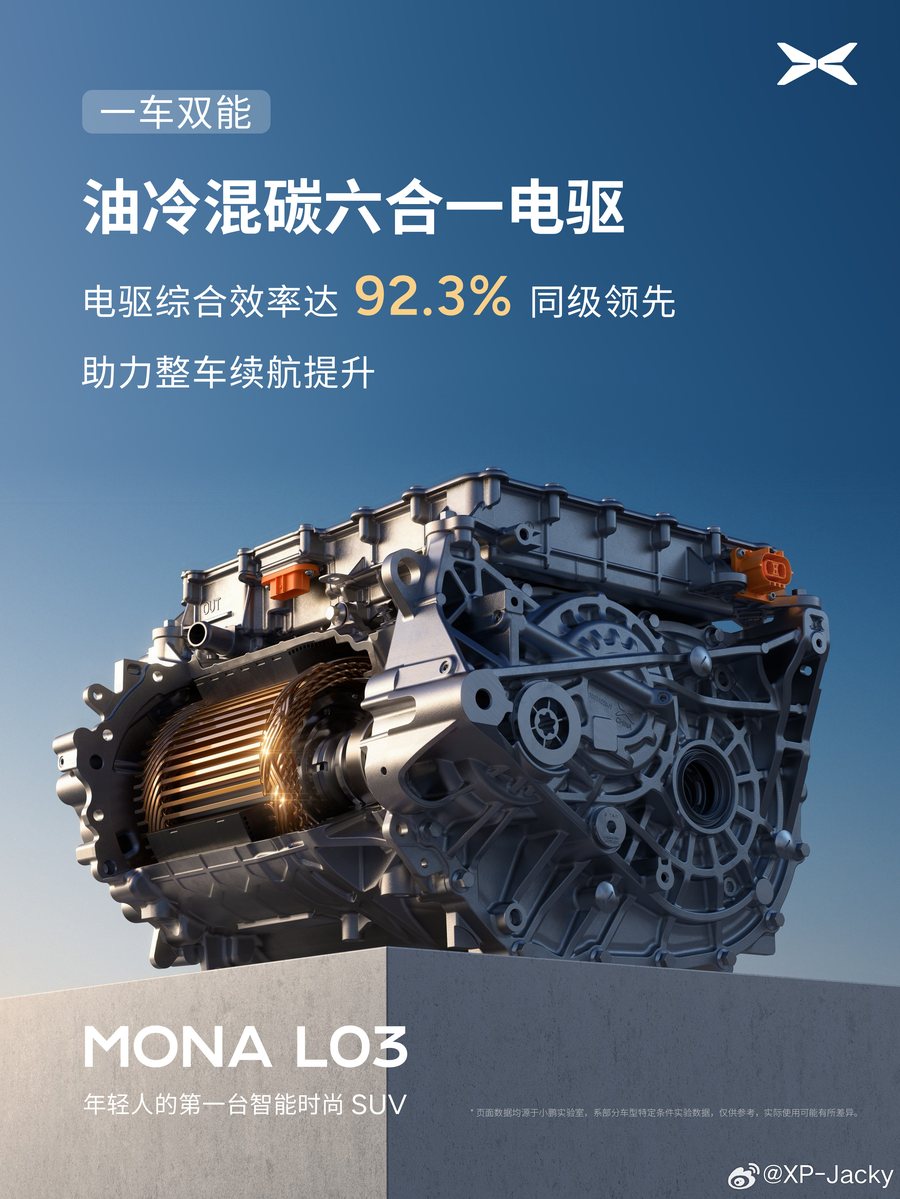
The e-drive as XPeng presents it: six functions in one housing, oil-cooled, with the MONA L03 below. Image: XP-Jacky (Weibo).
The three numbers
96.3% to 98.7%. This is the inverter's core efficiency under the CLTC cycle, comparing XPeng's hybrid silicon/silicon-carbide module against an all-silicon design. We have written about the underlying work before: it was published as "Commercialization and Cost-Optimization of a Hybrid Si/SiC EV Traction Inverter" in IEEE Power Electronics Magazine, and it made the June 2026 cover. XPeng's claim is that the hybrid arrangement reaches full-silicon-carbide-equivalent efficiency at lower cost, and that it has been in mass production since November 2025, with more than 15,000 vehicles on the road when the paper was submitted. That article is here.
92.3%. This is the number attached to the award, and it is a different measurement: the CLTC-cycle efficiency of the whole e-drive, not of the inverter alone. Hold on to the distinction, because the two get quoted interchangeably in Chinese coverage — 98.7% is a component, 92.3% is the system, and the gap between them is what the motor, the reducer and the oil circuit consume.
10.1 kWh/100 km. A real-road media test result, run in Huairou outside Beijing. That is consumption per vehicle, not efficiency per component — the number a buyer actually feels.
What the six-in-one integration buys
XPeng's description is about packaging rather than performance. The e-drive uses a "deeply integrated housing" to bundle six functions into one unit, which shrinks the assembly and — the part that matters to a customer — lowers the rear floor, freeing luggage space.
The L03's own numbers show the result: 4,650 mm long on a 2,850 mm wheelbase, with a 539-litre boot expanding to 1,640 litres, plus a 102-litre front compartment on the pure-electric versions. It is also slippery — a 0.228 drag coefficient after 22 aerodynamic changes, with the exterior led by JuanMa, the former Ferrari designer. A tall-ish SUV at that size with that much interior volume and that drag figure is the kind of package that makes a cheap car feel less cheap.
The oil circuit is the other half: XPeng says the e-drive uses a wide-temperature-range intelligent oil management system so winter efficiency does not collapse. That is the least glamorous sentence in the post and possibly the most consequential for buyers in cold markets — cabin heating and cold-soaked packs are where cheap EVs usually lose their efficiency claims.
What 10.1 kWh/100 km is worth
It is easy to read a consumption figure without translating it. At a rough Chinese home-charging rate of ¥0.60/kWh, 10.1 kWh/100 km is about ¥6 per 100 km; a car using 15 kWh/100 km costs about ¥9. Over 20,000 km a year that is roughly ¥1,200 versus ¥1,800 — a saving of around ¥600 a year, or one service visit. For an Australian owner at about A$0.30/kWh, the same figures are A$3.03 versus A$4.50 per 100 km, about A$220 a year at 15,000 km.
None of that is dramatic on its own. It becomes dramatic in this price bracket, where the purchase decision is made on total cost of ownership and the monthly repayment is smaller than the fuel bill it replaces. It is also the reason a hybrid inverter is the right engineering bet here: silicon carbide is the better switch, and it is the more expensive one. Mixing the two and getting the efficiency of the expensive option is how a ¥123,800 car gets to claim it.
The car underneath the award
The commercial context is what makes this more than a plaque. The L03 launched in Munich on 16 July 2026, a European unveiling for the model, at ¥123,800 for both the 550 km electric and the 1,380 km range-extender versions. It took 20,000 orders in seven minutes and 46,859 in the first hour.
Deliveries then ramped: 8,424 in August, more than 14,000 in September, and over 20,000 in October, the third consecutive monthly increase. The bigger MONA L05, launched on 29 October from ¥139,800, sold out its 5,000-unit stock allocation, and the e-drive is standard on both cars — the same unit, on the cheapest vehicles the company sells, not a flagship halo part.
That is the argument the award is really making. XPeng's MONA series has now passed 360,000 cumulative deliveries, and the M03 has led the ¥100,000–200,000 electric sedan segment for 24 consecutive months. A powertrain efficiency prize on a 12-to-15万 car moves more metal than one on a flagship.
What the numbers do not prove
- All three efficiency figures are XPeng's. The post's own footnote says the page data comes from XPeng's laboratory under specified test conditions. "Equivalent to full silicon carbide" is the company's equivalence claim, not an independent measurement — we flagged the same thing in September.
- The award is an industry panel. Real-car testing by a magazine and its judges is more than a marketing exercise, but it is not a homologation test, and the criteria are not published in the way a WLTP or CLTC figure is.
- 10.1 kWh/100 km is a media test, not a rating. Huairou in autumn, specific routes, a specific car. It is a good result, and it is not the number a buyer in a cold climate at highway speed will see.
- XPeng does not publish a CLTC consumption figure for the L03 on its configurator — the spec sheet lists battery size, range, charging times, motor output and even the EIS battery chip, but no kWh/100 km row. On a car marketed on running costs, that is an odd omission, and the media test is doing work the spec sheet should be doing.
- The six functions are not itemised in the post, so the "six-in-one" claim cannot be checked component by component from what XPeng published.
The bottom line
The interesting thing about this award is not that XPeng won a powertrain prize — it has been winning those. It is that the winning hardware sits under the cheapest car in the range, on a third consecutive month of rising deliveries — the latest above 20,000 — and that the engineering that earned it is a cost optimisation rather than a performance one.
A hybrid inverter is not exciting. But it is the difference between a budget EV that can claim silicon-carbide efficiency and one that cannot — and in a market where the ¥120,000 car is where the volume is, that is the version of the technology that matters.
Source: XP-Jacky (Weibo) — translated & adapted for XPENGTech.
Enjoyed this? Get the next one direct.
New articles, or a daily / weekly digest — delivered to your inbox.